
Table of Contents
ToggleStarting SEO on a brand-new website is always a challenge. Starting it on a website full of demo content, duplicate pages, and a structure Google could barely crawl. That is a different problem entirely.
This is the story of a B2B AI sales tool company that came to us with a WordPress site barely a month old. Technically broken, cluttered with placeholder content, and already sending the wrong signals to search engines. We had to undo the damage before we could build anything meaningful.
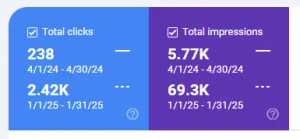
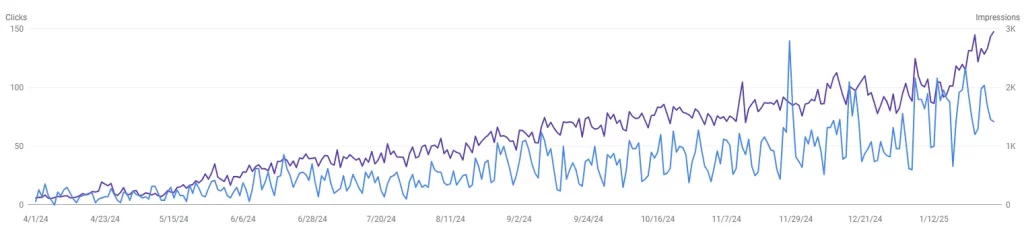
Ten months later, impressions had grown from 5,770 to 69,300, a 1,102% increase. Clicks went from 238 to 2,420, up 915.9%. This is how it happened.
Project Overview
| Detail | Info |
|---|---|
| CMS | WordPress |
| Niche | AI Sales Tools |
| Audience | B2B (Global) |
| Duration | 10 Months |
| Client Goals | Build organic foundation, grow brand awareness, drive qualified traffic |
What We Were Working With
The site had been live for just one month when the project began. That alone creates challenges: no domain authority, no content history, no search presence. But the real issue was what was already on the site.
The WordPress installation still had demo content loaded throughout. These were placeholder pages that looked like real content but carried no relevance to the business. Google was crawling them, indexing them, and surfacing the site for queries that had nothing to do with AI sales tools.
Duplicate content was another problem. Certain pages were essentially mirrors of each other, splitting what little authority the site had and confusing search engines about which version to rank. The navigation and URL structure made things worse. It was layered in a way that made deep pages difficult to reach, both for users and crawlers.
The result was a site health score sitting at 83. Google’s response to the irrelevant signals was already visible in the data, and without intervention, the trajectory would have continued downward.
The Audit: What Needed to Fix First
Before any content or keyword work, the technical foundation had to be rebuilt. There is no point optimizing pages that Google cannot properly access or understand.
The audit focused on four core areas:
- Website Structure The existing hierarchy was too complex. Pages were buried under unnecessary layers, making it harder for Googlebot to crawl efficiently and harder for users to navigate logically.
- Indexing and Crawlability Several important pages were blocked or deprioritized. At the same time, irrelevant demo pages were fully indexed. The opposite of what was needed.
- Canonicalization Duplicate pages lacked proper canonical tags, meaning no clear signal was being sent to Google about which URL should be treated as the primary version.
- Duplicate and Unnecessary Content Demo content, redundant pages, and irrelevant images were spread across the site. These needed to go entirely, not just be hidden or noindexed.
Strategy and Implementation
Once the audit identified what was broken, we worked through the fixes in a structured order: technical cleanup first, then content.
Cleaning Up the Site
Every demo page was removed. Unnecessary URLs, irrelevant images, and orphaned content were cleared out. The site structure was simplified to a flatter, more logical hierarchy that Google could index quickly and users could follow naturally.
Canonical tags were applied to resolve duplicate content. Redirect chains were cleaned. Pages that needed to be indexed were made accessible; pages that did not were properly handled.
On-Page Optimization
With the structure clean, we worked through the existing pages methodically. Titles, meta descriptions, H1 tags, and in-page content were updated with targeted keywords placed where they made editorial sense, not forced in.
Every on-page element was reviewed against what the target audience in the B2B AI tools space was actually searching for. The goal was relevance to intent, not just keyword presence.
Content and Topic Clusters
A brand-new site in a competitive niche needs topical authority. Publishing isolated articles is not enough. Google needs to see that a site covers a topic in depth.
We built out a topic cluster strategy around the core themes most relevant to the AI sales tools space: lead generation automation, sales conversation intelligence, B2B pipeline optimization, and AI-assisted outreach. Long-tail keywords anchored the content plan, with each article designed to cover a specific search intent while linking back to the key service pages.
Articles went live consistently throughout the campaign, gradually expanding the site’s content footprint in its niche.
Results
By month four, the signals were already strong. Impressions had grown from 2,594 to 23,143, a 792% increase. Clicks rose 285.3%, from 164 to 632. First-page keyword visibility jumped 472%, from 11 keywords to 63.
The full 10-month picture showed even sharper gains.
| Metric | Before | After | Change |
|---|---|---|---|
| Monthly Impressions | 5,770 | 69,300 | +1,102% |
| Monthly Clicks | 238 | 2,420 | +915.9% |
| Keywords on Google Page 1 | 11 | 63 | +472% |
| Pages on Google Page 1 | 17 | 25 | +47% |
| Website Health Score | 83 | 100 | Perfect |
| Organic Users (4-month) | 186 | 590 | +217.2% |
| Organic Sessions (4-month) | 259 | 881 | +240% |
The health score reaching 100 was significant. A clean, technically sound site gave every other optimization a proper foundation to build on.
The full 10-month picture showed even sharper gains.
What This Project Actually Demonstrates
The most important decision in this project was made before a single keyword was researched or an article was published. Removing the demo content, simplifying the structure, and fixing the technical layer. That was the work that made everything else possible.
AI is one of the most competitive niches in search right now. New tools, new companies, and new content are appearing every week. In that environment, a site cluttered with irrelevant signals and crawlability issues will not survive.
What did work was a deliberate sequence: fix the foundation, optimize what exists, then expand topical authority through consistent, targeted content. That sequence delivered measurable results at every stage of the 10-month engagement.
Frequently Asked Questions
How long does SEO take for a new WordPress site?
For a new domain, meaningful visibility usually starts to appear between months three and six, depending on how competitive the niche is. This project saw significant data shifts by month four, with the biggest gains compounding through month ten. Technical cleanup in the early weeks helped accelerate indexing considerably.
What is a website health score and why does it matter?
A health score measures the overall technical quality of a site: crawlability, broken links, redirect chains, on-page errors, and similar factors. This site started at 83. A score of 100 means no major technical issues are blocking search engine performance. Getting there removed the floor on what other optimizations could achieve.
Why was demo content such a serious problem for SEO?
WordPress demo content creates real pages with real URLs. Search engines crawl and index those pages, which means they register as content signals for the site. If that content is irrelevant to the business, Google associates the domain with irrelevant topics. The consequence is rankings for the wrong queries and wasted crawl budget on pages that should never have existed.
What is a topic cluster strategy and how does it help B2B SEO?
A topic cluster groups related content around a central theme. One pillar page covers the broad topic; supporting articles address specific subtopics and link back to it. For B2B sites, this approach builds topical authority in the niche. It is a signal Google uses to determine whether a site is genuinely expert in its subject area, rather than just producing isolated pieces of content.
Can SEO work in highly competitive niches like AI tools?
Yes, but the approach matters. Competing on short, high-volume keywords against established domains is difficult for a new site. The more effective path is building authority through long-tail content, demonstrating EEAT (Experience, Expertise, Authoritativeness, Trustworthiness) through the quality of the content, and earning first-page visibility on specific, intent-driven queries before moving into broader competition.
How were keywords chosen for this project?
The keyword research process started with the target audience: B2B buyers and decision-makers evaluating AI sales tools. From there, we mapped out the questions, comparisons, and use-case searches they were actually performing. Long-tail keywords were prioritized for the content strategy because they carry higher purchase intent and are more achievable for a newer domain. Core commercial keywords were optimized on service pages as the domain authority grew.
About the Author

Ashan Kusalanka
SEO Consultant with 10+ years of experience helping local and global businesses strengthen their digital presence. I design strategies that improve visibility, build authority, and drive sustainable growth.