Table of Contents
ToggleGoogle processes roughly 8.5 billion searches every single day. The algorithm deciding which pages appear at the top of those results has never stopped changing, and that is entirely by design.
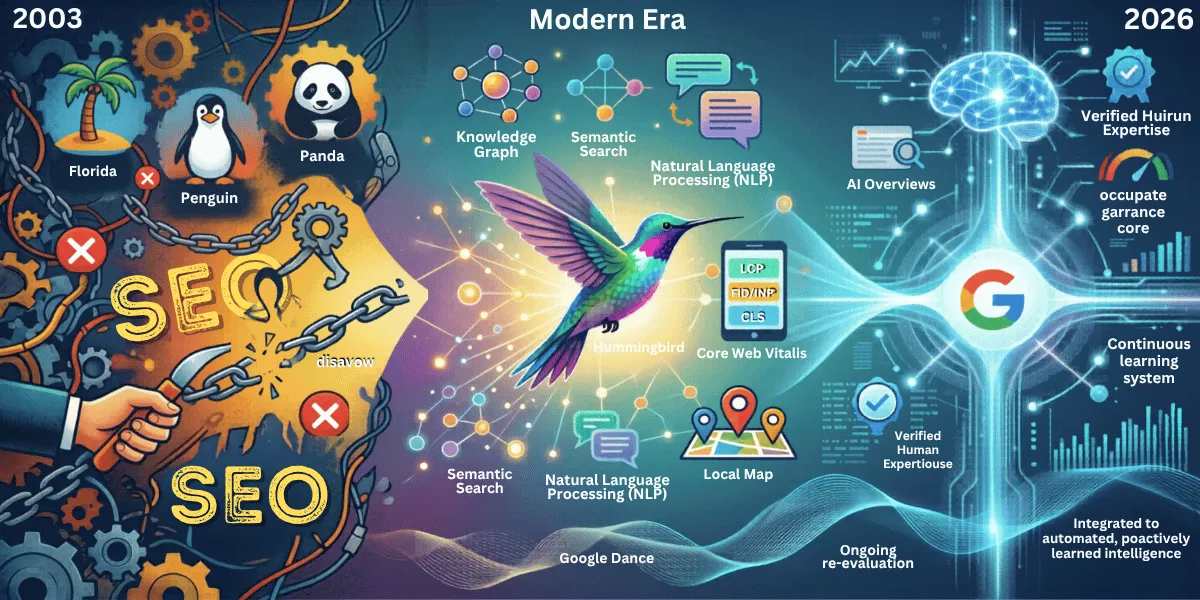
Since 2003, Google has rolled out hundreds of named updates and thousands of smaller, unannounced adjustments. Some targeted specific spam tactics. Others rebuilt how Google understood language itself. A few rewrote the rules of SEO overnight. Together, they tell the story of a search engine becoming smarter, more contextual, and increasingly harder to manipulate.
This guide covers every major Google algorithm update from Florida in 2003 through the March 2026 core update. It explains what each update targeted, why Google made the change, and what it meant for anyone trying to rank a website. Whether you are diagnosing a traffic drop or building a long-term SEO strategy, this is the reference you need.
Quick Reference: Key Terms
- Algorithm: The set of rules and signals Google uses to rank pages in search results.
- SERP (Search Engine Results Page): The page you see after running a Google search.
- Core Update: A broad reassessment of how Google evaluates content quality and relevance across the entire web.
- Indexing: The process by which Google discovers, crawls, and stores web pages so they can appear in search results.
- Spam Update: A targeted update aimed at sites using manipulative tactics that violate Google’s policies.
The Hall of Fame: Iconic Legacy Updates (2003–2017)

Before Google formalized its core update process, it released named updates targeting specific problems. Each one drew a new line in the sand. These 18 updates permanently changed how SEO works, and understanding them explains why modern SEO looks the way it does.
The Cheat Sheet
Update | Year | Primary Target |
|---|---|---|
2003 | Keyword stuffing and manipulative affiliate tactics | |
2005 | Link farms, paid links, reciprocal linking schemes | |
2005–06 | URL canonicalization, redirect handling, indexing infrastructure | |
2009 | Brand authority as a proxy for trust | |
2010 | Indexing speed and real-time content freshness | |
2011 | Thin, duplicate, and low-quality content | |
2011 | Recency signals for time-sensitive queries | |
2012 | Excessive above-the-fold advertising | |
2012 | Localized results based on IP and search intent | |
2012 | Manipulative link building and over-optimized anchor text | |
2012 | Keyword-stuffed domains with thin content | |
2013 | Spammy high-abuse query verticals | |
2013 | Semantic search, context and intent over keyword matching | |
2014 | Local search quality aligned with web ranking signals | |
2015 | Mobile-friendliness as an explicit ranking requirement | |
2015–present | Site utility, intent match, overall user experience | |
2015 | Machine learning for novel, never-before-seen queries | |
2017 | Monetization-first sites with thin user value |
A Quick Glossary Before We Go Further
- Black Hat SEO: Tactics designed to manipulate search rankings in ways that violate Google’s guidelines. Think paid links, keyword stuffing, and hidden text.
- White Hat SEO: Ethical optimization practices that align with Google’s guidelines and focus on genuine user value.
- Link Farm: A network of websites created specifically to generate backlinks and manipulate PageRank.
- Anchor Text: The clickable, visible text of a hyperlink. Over-optimized anchor text (for example, every backlink saying “best cheap loans”) was a major spam signal.
Florida (2003)
Florida arrived in November 2003, right as e-commerce sites were ramping up for the holiday season. The timing made the impact impossible to ignore.
The update targeted keyword stuffing and manipulative affiliate tactics that had become standard practice in early-2000s SEO. Sites were cramming their pages with keywords, sometimes invisible to users but readable by bots, and ranking well for it. Florida made that strategy collapse overnight.
Entire industries lost rankings within days. Some businesses that had built their revenue on those rankings simply ceased to operate.
Florida’s legacy is not just the sites it destroyed. It established the precedent that Google would fight ranking manipulation through algorithm changes. Every update that followed was built on that principle.
Jagger (2005)
Jagger targeted the link manipulation tactics that flourished after Florida. Specifically: reciprocal link exchanges, paid links, and link farms.
The logic behind those tactics was straightforward. Google used backlinks as votes of confidence. More links meant more authority. So webmasters built networks of sites to link to each other, bought links from high-PageRank pages, and traded links with anyone willing.
Jagger sent a clear message. Link quantity without link quality is not just unhelpful. It is a liability.
That message has only gotten stronger in the two decades since.
Big Daddy (2005–2006)
Big Daddy was not a content or link update. It was an infrastructure change, specifically the first major overhaul of how Google handled URL canonicalization, redirects, and duplicate content processing at scale.
Sites with messy URL structures, broken redirect chains, or multiple versions of the same page serving different content saw significant ranking instability during the rollout.
For the first time, SEOs had to think technically, not just editorially. Big Daddy planted the seeds of what we now call technical SEO as a discipline.
Vince (2009)
Vince gave established brand domains a noticeable ranking boost for high-volume commercial queries. Where smaller affiliate sites had previously competed with major brands on relatively even footing, the gap widened significantly after Vince.
Google’s reasoning was simple. Brand recognition is a proxy for trust. If millions of people search for a brand by name, visit its site directly, and engage with its content, that behavior signals authority in a way that manipulated links cannot replicate.
Vince introduced brand authority as an implicit ranking factor. That concept runs through every major update through 2026.
Caffeine (2010)
Caffeine is often misunderstood. It was not a ranking change. It was a complete rebuild of Google’s web indexing infrastructure.
Before Caffeine, Google’s indexing system processed the web in large batches. Fresh content could sit unindexed for days or weeks as a result. Caffeine changed that by indexing content continuously, reducing the time from publication to appearance in search results by roughly 50%.
News articles, blog posts, and social content could now appear in SERPs almost immediately after publication. Real-time search became viable.
Caffeine also laid the infrastructure foundation that made the Freshness Algorithm, Hummingbird, and eventually AI-powered search signals possible. It is one of the most consequential updates that almost nobody talks about.
Panda (2011)
Panda was a direct response to the rise of content farms, websites publishing thousands of shallow, ad-heavy articles designed to rank for long-tail keywords rather than inform readers. Sites like Demand Media and eHow had built entire businesses on this model.
What made Panda different from every update before it was the unit of measurement. Panda did not penalize individual bad pages. It assigned a quality score to entire domains. If a substantial portion of a site’s content was thin, duplicate, or low-value, the entire domain’s rankings were suppressed.
Recovery required more than fixing a few pages. Sites had to audit, prune, or significantly improve their content at scale, then wait for the next Panda refresh before seeing any recovery signal.
Panda was absorbed into Google’s core algorithm in 2016, meaning its quality evaluation became continuous rather than periodic. That shift changed everything about how content strategy works.
Freshness Algorithm (2011)
The Freshness Algorithm adjusted how much weight Google gave to content recency, but it did so selectively by query type.
Queries about breaking news, recent events, and regularly recurring topics triggered freshness signals, pushing newer content higher. Queries about stable topics, like how to tie a knot or the history of Rome, were largely unaffected.
This was an important distinction the SEO community initially missed. Freshness was not a mandate to update all content constantly. It was a signal that query intent should determine how recency factors into ranking.
That principle of query-type-based ranking logic became a cornerstone of Hummingbird two years later.
Page Layout Algorithm (2012)
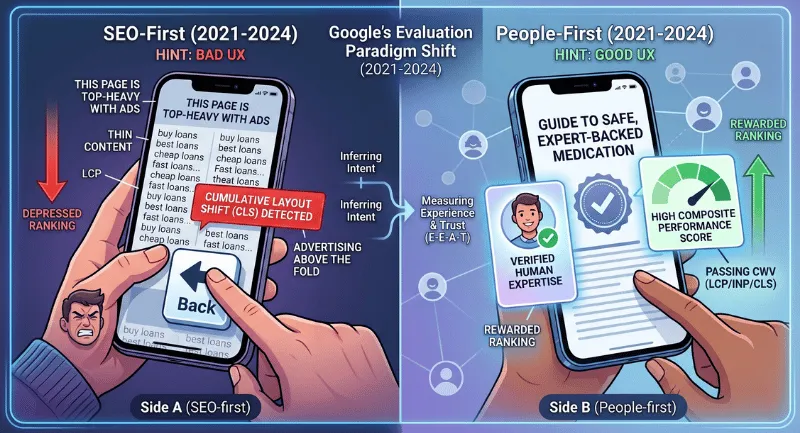
The Page Layout Algorithm penalized sites where users had to scroll past excessive advertising before reaching any actual content. The targets were pages that were top-heavy with ads, a design pattern common in media and affiliate publishing at the time.
This was Google’s first clear statement that page user experience is a ranking consideration, not just content quality.
The logic was simple. If a user clicks a search result and has to hunt for the content they came for, that is a bad experience. Google’s results should not consistently send people to bad experiences.
Page Layout planted the philosophical seed for Core Web Vitals, the Page Experience Update, and every UX-based ranking signal that followed.
Venice (2012)
Venice quietly reshaped how organic search results worked for queries with local intent, even when no location was specified in the search.
Before Venice, a search for “coffee shop” returned national or generic results unless the user explicitly typed a city name. Venice used the searcher’s IP address and location data to infer local intent and serve geographically relevant results.
Local businesses suddenly found themselves appearing in results they had previously been invisible in. National sites that had dominated broad queries started losing ground to locally relevant competitors.
Venice is the origin point of modern local SEO. Everything that followed, from Pigeon to local pack results to Google Maps ranking signals, was built on the foundation Venice established.
Penguin (2012)
Penguin was one of the most disruptive updates in Google’s history. It directly targeted the link-building practices that an entire industry had built itself around.
Paid links, link farms, and anchor text over-optimization were the primary targets. Sites that had invested heavily in these tactics saw rankings collapse, often for years. Google launched the Disavow Tool shortly after as the primary recovery mechanism, allowing webmasters to tell Google which backlinks to ignore.
Penguin 4.0, released in 2016, changed the mechanics significantly. The update became real-time, meaning sites were no longer waiting months for refreshes to see the impact of link changes. It also shifted from site-wide action to page-level action, allowing pages with clean link profiles to rank even if other sections of the site had problems.
Penguin permanently redefined link building from a volume game to a quality and relevance game. That definition has not changed.
EMD: Exact Match Domain (2012)
The EMD update removed the disproportionate ranking advantage that keyword-stuffed domain names had been providing to low-quality sites.
A domain like “best-cheap-car-insurance.com” could rank well for “best cheap car insurance” simply because of the URL, regardless of the content behind it. Google recognized the pattern and corrected it.
The update did not penalize exact match domains categorically. A site with a keyword-rich domain and genuinely high-quality content was not affected. The signal was clear: the domain name is one small factor among hundreds, and content quality determines whether that factor helps or hurts.
Payday Loan Update (2013)
The Payday Loan Update addressed a specific problem that general quality updates could not efficiently solve. Certain query verticals, including payday loans, casinos, pharmaceuticals, and adult content, had become so dominated by spam that cleaning them up required a targeted intervention.
This was the first time Google applied update logic selectively by topic vertical rather than by site quality alone. It affected a narrow slice of the search landscape but demonstrated that Google could target specific categories of manipulative content when the problem was severe enough.
Hummingbird (2013)
Hummingbird was not an update. It was a replacement.
Google replaced the core of its search algorithm to enable something that keyword-matching could never achieve: understanding what a query actually means, not just what words it contains. Hummingbird allowed Google to process conversational queries, long-tail questions, and semantically complex searches by understanding context and intent.
A search like “what is the closest place to buy medicine near me open now” requires understanding location, time, intent, and the relationship between those concepts. Hummingbird made that kind of interpretation possible.
How Google Understands Language
- Semantic Search: Search that understands the meaning behind a query, not just the individual words. “Where can I get coffee nearby?” and “coffee shops close to me” express the same intent.
- Entity: A specific, identifiable thing such as a person, place, organization, or concept. Google’s Knowledge Graph maps relationships between entities to understand context.
- Natural Language Processing (NLP): The branch of AI that enables computers to understand, interpret, and generate human language.
Hummingbird’s legacy extends far beyond 2013. It was the architectural foundation that made RankBrain possible in 2015, BERT in 2019, and every AI-powered ranking signal that has followed. Without Hummingbird, the modern algorithm does not exist.
Pigeon (2014)
Pigeon aligned local search ranking signals with the traditional web ranking algorithm. Before Pigeon, local results operated somewhat independently. A business could rank well in local results through directory citations alone, without meeting the same quality standards applied to web results.
Pigeon changed that by applying core web ranking logic to local results. Backlinks, on-page optimization, domain authority, and content quality all began influencing local rankings more directly.
Distance, relevance, and prominence became the three pillars of local ranking. For SEOs, Pigeon confirmed that local and organic are not separate disciplines. They are the same discipline applied to different result types.
Mobilegeddon (2015)
In April 2015, Google made mobile-friendliness an explicit ranking signal for mobile search results. The SEO community named it “Mobilegeddon” in anticipation of widespread ranking upheaval.
The upheaval was real. Sites without responsive design or mobile optimization dropped in mobile SERPs. Estimates suggested more than 40% of web pages were affected in some way.
The reasoning was clear. Mobile traffic had overtaken desktop globally. Users landing on non-responsive sites encountered broken layouts, tiny text, and impossible navigation. Google’s results were consistently sending mobile users to bad experiences, and the algorithm needed to reflect the reality of how people actually searched.
Mobilegeddon was the starting point. Mobile-first indexing, where Google uses the mobile version of a page as the primary basis for ranking, completed its full rollout in 2023. The direction throughout has been consistent: mobile is the default, not the afterthought.
Quality Updates (2015–Present)
From 2015 onward, Google began rolling out a series of updates with no official names and no formal announcements, observable only through ranking volatility. The SEO community called them “Phantom” updates.
These updates targeted intent match, site utility, and overall user experience in ways that were difficult to isolate. Sites in health, finance, and legal categories were disproportionately affected, which introduced a concept Google would later formalize.
What Is YMYL?
YMYL stands for “Your Money Your Life.” It refers to content that can significantly impact a person’s health, financial stability, safety, or wellbeing. Medical advice, legal guidance, financial planning content, and public safety information all fall into this category. Google holds YMYL content to a substantially higher quality and trust standard because the consequences of bad information in these areas are genuinely serious.
When Panda was absorbed into the core algorithm in 2016, quality evaluation stopped being a periodic event and became a continuous process. The Quality Updates era represented the first stage of that transition.
RankBrain (2015)
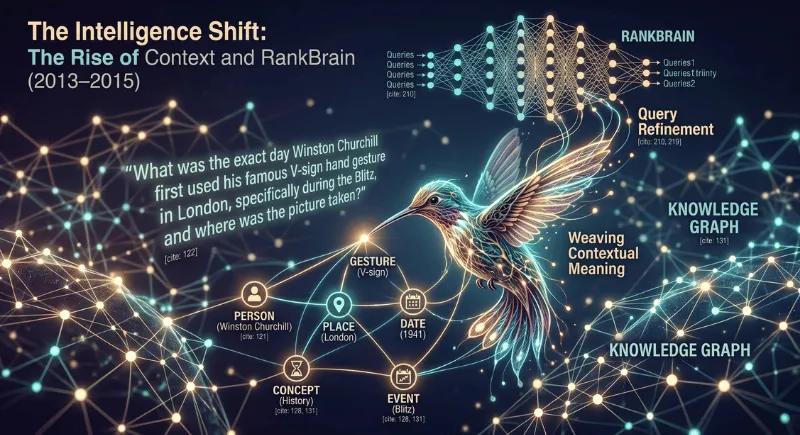
In October 2015, Google confirmed what it had been running quietly for months. A machine learning system called RankBrain was processing search queries and influencing rankings. At launch, it was confirmed as the third most important ranking signal.
RankBrain’s specific purpose was handling queries Google had never seen before. A significant percentage of daily searches, which Google has cited at around 15%, are genuinely novel. No human could pre-program the right answer to every unique phrasing of a question. RankBrain solved this by learning to map unfamiliar queries to conceptually similar ones it already understood.
It also learned from user behavior. When people clicked a result and quickly returned to the SERP, that was a signal the result did not satisfy the query. When they stayed, scrolled, and engaged, that was a signal it did.
The implications for SEO were significant. Keyword matching became less important than topical relevance. Ranking for a page is not just about the words on that page. It is about whether users who arrive find what they were actually looking for.
Fred (2017)
Fred targeted a specific type of site, one built primarily to generate advertising or affiliate revenue where content was a vehicle for monetization rather than a product in itself.
Health, finance, and lifestyle blogs with thin articles surrounding aggressive ad placements were hit hardest. The content-to-ad ratio mattered. The depth of the content mattered. Whether the site existed to inform users or to capture their click and redirect them elsewhere mattered.
Fred’s philosophy did not disappear after 2017. It evolved, became more sophisticated, and eventually formed the conceptual basis for the Helpful Content Update in 2022.
The Modern Era (2021–March 2026)
After 2020, Google’s update cadence accelerated dramatically. What had been a handful of major named updates per year became a near-continuous cycle of core updates, spam updates, and system-level changes. Each year brought not just new updates, but a new chapter in Google’s ranking philosophy.
2021: Page Experience Becomes a Ranking Signal
The Page Experience Update, rolled out between June and August 2021, introduced Core Web Vitals as official ranking signals. Three metrics defined the standard.
- LCP (Largest Contentful Paint) measures how long it takes for the main content of a page to load.
- FID (First Input Delay) measures how quickly the page responds to a user’s first interaction.
- CLS (Cumulative Layout Shift) measures how much the page layout shifts unexpectedly while loading.
For years, technical SEOs had argued that site speed and stability affected rankings indirectly through user behavior signals. The Page Experience Update made it direct and explicit.
The November 2021 Local Search Update also reshaped local rankings significantly, rebalancing factors in a way that affected local businesses across verticals. Combined, 2021 was the year Google formally committed to measuring user experience at a technical level rather than inferring it from engagement signals alone.
2022: People-First Content and the E-E-A-T Expansion
The May 2022 Core Update was the first broad core update in over six months and produced significant SERP volatility. But the defining moment of 2022 came in August.
The Helpful Content Update introduced a sitewide ranking signal unlike anything Google had deployed before. If a substantial portion of a site’s content was written primarily to perform well in search rather than to genuinely help readers, the entire domain could be depressed in rankings, not just the offending pages.
This was a fundamental shift. A site could no longer compensate for hundreds of thin, SEO-first pages by having a handful of great ones. The entire content operation had to be oriented toward human readers.
In September, the September 2022 Core Update became the first to explicitly evaluate content against E-E-A-T signals. Then, in December, Google made a quiet but significant change to its quality rater guidelines by adding Experience to the existing E-A-T framework, creating E-E-A-T.
What Is E-E-A-T?
- Experience: Has the author actually used the product, visited the place, or lived through the situation they are writing about?
- Expertise: Does the author have the knowledge or qualifications relevant to the subject matter?
- Authoritativeness: Is the site or author recognized as a credible source within their field?
- Trustworthiness: Is the content accurate, transparent, and backed by verifiable information?
E-E-A-T is not a direct ranking factor. Google’s systems cannot read an author bio and assign a numerical score. But it describes the qualities the algorithm increasingly rewards through indirect signals: author entity recognition, citation patterns, external reputation, and user engagement.
2023: The AI Inflection Point
2023 was the year the SEO community was forced to seriously reckon with AI-generated content at scale.
Google’s updates that year were not primarily responding to AI directly. They were building the quality enforcement infrastructure needed to address what was clearly coming. The Helpful Content classifier was tightened in September, the review system was expanded and eventually merged into the core algorithm, and concurrent core and spam updates became a new pattern.
The most notable updates of the year:
- August 2023 Core Update brought broad quality reassessment with significant SERP volatility across most verticals.
- September 2023 Helpful Content Update tightened the classifier further. Independent publishers were hit hardest. Sites that had seen partial traffic recovery from previous updates lost ground again.
- October 2023 saw a core update and spam update running simultaneously. This overlap became a recurring pattern that made post-update diagnosis significantly more complex.
- November 2023 Core Update was the most volatile update of the year, affecting rankings across virtually every vertical.
By the end of 2023, Google had processed enough feedback on the Helpful Content system to know it needed a more thorough response. What came in March 2024 was the result.
2024: The March Core Update
The March 2024 Core Update was the most consequential algorithm change since Panda in 2011. Its 45-day rollout, the longest in Google’s history, combined a core algorithm refresh with three sweeping new spam policies.
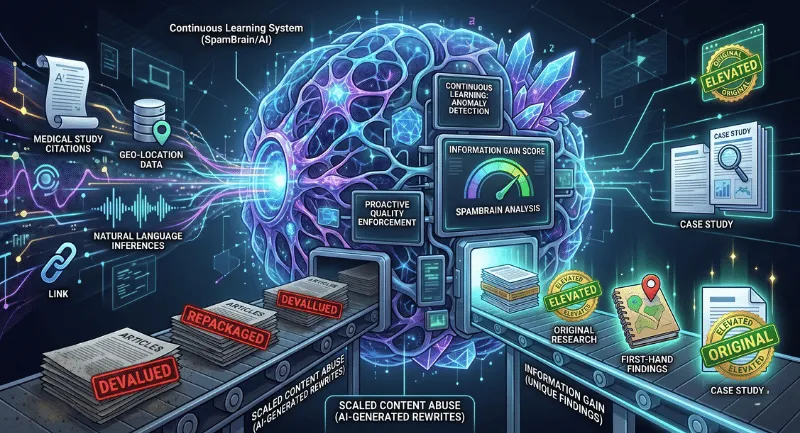
- Scaled Content Abuse targeted the mass production of low-value content, whether AI-generated or human-written, purely to target ranking opportunities.
- Site Reputation Abuse addressed the practice of publishing third-party content on established, high-authority domains to benefit from their existing PageRank. This practice had become widely known as parasite SEO.
- Expired Domain Abuse targeted sites built on purchased expired domains with existing authority, populated with thin or irrelevant content to inherit ranking power.
The Helpful Content system was simultaneously integrated into the core algorithm, meaning it was no longer a separate evaluation layer. Every core update from this point forward would incorporate helpful content signals automatically.
The impact was severe. Significant de-indexing events occurred across affiliate publishing, AI content operations, and programmatic content sites in health, finance, and lifestyle verticals. Sites that had grown rapidly through scaled AI content generation lost the majority of their visibility within weeks.
The rest of 2024 continued with substantial update activity. The August 2024 Core Update took feedback from independent publishers into account, and some quality-focused smaller sites began seeing partial recovery. By December, Google was signaling explicitly that the future would bring more frequent updates rather than fewer.
2025: AI Overviews and a Record Update Volume
2025 was defined by two parallel developments: the mainstream integration of AI Overviews into Google Search, and the highest confirmed update volume in Google’s history.
AI Overviews, formerly the Search Generative Experience (SGE), moved from a lab feature to a standard component of Google’s search results. For an increasing range of queries, users saw an AI-generated summary at the top of the page, above organic results. The implications for organic traffic were significant.
The SEO objective shifted as a result. Ranking well remained necessary but was no longer sufficient on its own. Getting cited as a source within AI Overviews became a separate and increasingly important objective.
Seven confirmed updates rolled out across 2025, the highest annual volume on record. Google alternated between core and spam updates, rarely leaving more than six weeks between confirmed rollouts.
2026: Compounding Complexity and the Information Gain Era
The first two months of 2026 alone brought two significant updates.
The February 2026 Discover Core Update was notable because it targeted Google Discover specifically rather than web search. It prioritized locally relevant content and reduced the reach of sensationalist and clickbait content within the Discover feed. Local publishers saw traffic shifts, and content strategies built around Discover visibility had to be reconsidered.
The March 2026 Spam Update (March 24) ran concurrently with the March 2026 Core Update (March 27), continuing the overlapping update pattern established in late 2023.
The March 2026 Core Update introduced three forward-facing signals that define where Google’s algorithm is heading.
Holistic Core Web Vitals Composite Scoring changed how performance is measured. LCP, INP, and CLS are no longer evaluated as independent pass/fail signals. They are aggregated into a single composite performance score, where all three metrics contribute to one ranking factor. Sites that had optimized for two out of three metrics now face a more demanding standard.
Information Gain is perhaps the most consequential new concept. Google is actively rewarding content that adds genuinely new information to the web, original research, first-hand findings, perspectives not already covered by existing top-ranking pages. Content that simply repackages what already ranks is facing measurable devaluation.
Brand Authority and Verified Human Expertise have also increased in weight. Verifiable author identity, organizational credibility, and real-world reputation are now stronger trust signals. AI-generated content without clear human editorial oversight faces stronger headwinds.
The Anatomy of a Core Update
What a Core Update Actually Is
A core update is not a penalty. That distinction matters enormously for how sites should respond to one.
When Google runs a core update, it is not identifying and punishing specific sites for specific violations. It is re-evaluating the entire web against an updated understanding of what quality, relevance, and helpfulness mean. A site that drops after a core update has not necessarily done anything wrong. It may simply be that other sites now better satisfy the updated standard.
This means the response to a core update is not to fix a specific technical error or remove a piece of bad content. It is to ask a harder question: does this site genuinely provide the best possible answer to the queries it ranks for?
The Evolution of Google's Ranking Philosophy
The philosophical arc of Google’s algorithm runs in one consistent direction.
Keywords (pre-2013). Match the words in the query to words on the page.
Entities (post-Hummingbird, 2013). Understand what the query is about, not just what it says.
Intent (post-RankBrain, 2015). Understand what the user is trying to accomplish.
Experience (post-Page Experience, 2021). Evaluate whether the page delivers a good experience in addition to relevant content.
Information Gain (2026). Reward content that adds something new, not just content that covers existing ground competently.
Each stage built on the previous one. The algorithm has never retreated to an earlier stage.
The Evolution of Google's Ranking Philosophy
During any major update rollout, search rankings fluctuate, sometimes dramatically, before settling into their new positions. The SEO community has called this the “Google Dance” for decades.
The volatility is not random. It reflects Google processing large volumes of new quality signals, testing different weighting configurations, and gradually stabilizing. Rankings during an active rollout are unreliable indicators of the final outcome. Sites that react by making aggressive changes during a rollout often create additional instability rather than resolving the original issue.
Two Types of Google Action
- Algorithmic Action: An automated quality or spam signal that suppresses a site or page in rankings. Recovery requires fixing the underlying issue and waiting for re-evaluation during the next crawl cycle.
- Manual Action: A human reviewer at Google has determined that a site violates spam policies and manually removed or demoted it. Visible in Google Search Console. Recovery requires submitting a reconsideration request after resolving the issue.
- SpamBrain: Google’s AI-powered spam detection system. Deployed at scale from 2022 onward to identify unnatural links, AI-generated spam, and policy violations without manual review.
How to Survive and Thrive After an Algorithm Update
Content Quality and Information Gain
The single most consistent pattern across 23 years of Google algorithm updates is that genuinely useful content recovers and grows, while content built for rankings alone declines.
In 2026, that standard has sharpened. Useful is no longer enough on its own. Content that covers a topic thoroughly but adds nothing beyond what already exists faces pressure from Google’s Information Gain signal. The question is not just “is this accurate and comprehensive?” It is “does this add something the user cannot find somewhere else?”
Original research, first-hand experience, proprietary data, and perspectives grounded in genuine expertise all satisfy this standard. Rewrites and summaries of existing top-ranking content increasingly do not.
Content Quality and Information Gain
The March 2026 shift to composite Core Web Vitals scoring raises the bar for technical performance. Optimizing LCP while leaving CLS unaddressed is no longer a viable approach. All three metrics contribute to a single score, and the weakest metric pulls down the others.
HTTPS, mobile usability, structured data, and clean crawlability remain foundational requirements. Sites that have not addressed these fundamentals are competing at a structural disadvantage that no amount of content quality can fully overcome.
Trust Signals and E-E-A-T
E-E-A-T cannot be faked, but it can be built deliberately.
Author bios with verifiable credentials, citations from authoritative external sources, organizational transparency through clear About pages and editorial policies, and a real-world entity footprint including press coverage and industry mentions all contribute to how Google’s systems evaluate trustworthiness.
For YMYL content especially, thin or anonymous authorship is a significant liability. A medical article with no named author and no sourcing is competing against hospital websites and peer-reviewed research. That competitive gap is not recoverable through keyword optimization alone.
User Behavior Signals
Since RankBrain in 2015, user engagement signals have played an increasing role in ranking decisions. Pages that users visit and quickly abandon send a different signal than pages where users scroll, read, and engage.
Dwell time, scroll depth, return visits, and low bounce rates all indicate that a page is satisfying the intent behind the query. These signals are not directly controllable. They are the output of good content, good design, and accurate expectation-setting in the title tag and meta description.
The best way to improve engagement signals is not to optimize for them directly. It is to create pages that genuinely deserve the engagement.
The Proactive Mindset
Every recovery story from a major algorithm update follows the same pattern. The sites that bounced back fastest were the ones already investing in quality. The update did not damage them severely in the first place, or the signals needed for recovery were already present.
The sites still waiting for recovery years after a major update are the ones trying to build quality signals in response to a penalty. That is the harder and slower path.
How to Monitor Algorithm Updates
Tracking Google updates accurately requires using the right sources in combination.
Google Search Status Dashboard (status.search.google.com) is the official, real-time record of confirmed Google updates and the most reliable first source for verification.
Google Search Central Blog is where Google publishes policy changes, algorithm explanations, and major update announcements with guidance for site owners.
SEMrush Sensor measures daily SERP volatility across verticals. It is useful for identifying whether ranking changes correlate with a broader update or are site-specific.
MozCast is a temperature-based metric reflecting day-to-day SERP turbulence. Higher temperatures indicate more algorithmic activity across the web.
Google Search Console is the essential diagnostic tool. When a traffic drop occurs, the Performance report shows which queries and pages lost visibility, and the Coverage report identifies indexing issues.
When rankings drop, the first step is always correlation, not action. Identify whether the drop aligns with a confirmed update date. Determine whether it affects the entire site, specific sections, or individual pages. Only then does it make sense to begin diagnosing the likely cause. Reacting before understanding the cause almost always creates additional problems.
What 23 Years of Updates Tell Us
Twenty-three years of algorithm changes, from Florida to March 2026, tell one coherent story.
Google started by fighting specific tactics: keyword stuffing, link manipulation, thin content, ad-heavy pages. As each tactic was addressed, the SEO community found new ones. Google’s response evolved from reactive rule-making to proactive systems thinking. The algorithm stopped chasing individual tactics and started evaluating the underlying quality they were trying to simulate.
Today, the things that algorithm updates reward, original expertise, genuine user value, technical performance, real-world authority, are the same things that would have served readers well in 2003. The algorithm has simply become sophisticated enough to measure them accurately.
The sites that consistently rank well across update cycles are not the ones that optimized most cleverly for each new signal. They are the ones that built something worth ranking. That has been the point of every Google update since the beginning.
Ready to go deeper? Each iconic update covered in this guide has its own dedicated article with full technical detail, the sites it affected, the recovery strategies that worked, and the lasting lessons it left behind.
Individual deep-dives coming soon: Florida, Panda, Penguin, Hummingbird, the Helpful Content Update, the March 2024 Core Update, and more.
What I See in Google Algorithm Updates
After working in SEO for ten years and watching update after update roll through, one thing has become obvious to me.
Every update Google has ever released, whether it is a core update, a spam update, a Discover update, or anything else, comes back to the same fundamental question. Are the people using Google getting what they actually came for?
Google’s real clients are not website owners. They are not SEO professionals. They are the billions of people typing queries into that search bar every day. If Google consistently sends those people to low-quality pages, irrelevant results, or content that wastes their time, those people will stop using Google. That is a business failure for Google, plain and simple. Every algorithm change is Google protecting that relationship.
Once you understand that, SEO becomes a lot clearer.
There are no shortcuts that hold. Every trick that worked for a while, keyword stuffing, link schemes, thin AI content, parasite SEO, eventually met an update specifically built to end it. The SEO community keeps learning this lesson, and Google keeps teaching it.
What I tell clients is straightforward. Stop thinking like a publisher trying to rank and start thinking like the algorithm trying to serve a user. What does this person actually need? What would make them close the browser satisfied rather than hit the back button?
That said, I want to be clear about something. Experienced SEOs do more than just create good content and hope for the best. Knowing how to send the right signals to Google is a real skill. Technical structure, internal linking, entity optimization, E-E-A-T signals, crawlability, Core Web Vitals. These are not gimmicks. They are how you communicate quality to a system that cannot read your content the way a human does.
The difference between a strong SEO strategy and a weak one is not whether you follow Google’s guidelines. Most people follow the guidelines. The difference is knowing how to make Google understand, at a technical and structural level, that your content deserves to rank.
Build genuinely for users. Then signal that quality clearly and strategically. That combination is what has always worked, and based on everything I have seen across 23 years of algorithm history, it is what will keep working.
SEO, GEO and AEO: Why the Fundamentals Never Changed
Ten years in search teach you one thing above everything...
Read MoreFrequently Asked Questions
What is a Google core algorithm update?
A core update is a broad reassessment of how Google evaluates content quality and relevance across the entire web. Unlike spam updates, which target specific manipulative tactics, core updates re-evaluate all pages against an updated standard of what “high quality” means. Sites can gain or lose rankings without having changed anything on their end, because the standard they are being measured against has changed.
How often does Google update its search algorithm?
Google makes thousands of small, unannounced adjustments to its algorithm every year. On top of those, it releases several major confirmed updates annually. In 2025, Google confirmed seven named updates, the highest annual volume on record. Google has signaled that this pace will continue, and the overlap of core and spam updates running simultaneously is now a regular occurrence rather than an exception.
How do I know if a Google update affected my website?
The clearest signal is a correlation between a traffic drop in Google Search Console and a confirmed update date from the Google Search Status Dashboard. If your impressions and clicks fell sharply around the same time Google confirmed an update, that update is likely the cause. Look at which pages and queries were affected. This tells you whether the issue is sitewide or concentrated in a specific section of the site.
What is the difference between a core update and a spam update?
A core update broadly re-evaluates content quality and relevance across the web. Any site can be affected, including sites that have not violated any policies. A spam update targets sites using manipulative tactics that violate Google’s guidelines, including link schemes, AI-generated content at scale, cloaking, and similar practices. The two types of updates often run concurrently now, which can make post-update diagnosis more complex.
What is E-E-A-T and how does it relate to algorithm updates?
E-E-A-T stands for Experience, Expertise, Authoritativeness, and Trustworthiness. It describes the quality signals Google’s systems increasingly reward. It is not a direct ranking factor with a numerical score attached. But it represents the qualities that consistently correlate with ranking well across core updates: content created by people with genuine knowledge, hosted on sites with verifiable credibility, covering topics they have real-world experience with.
Which Google algorithm update had the biggest impact on SEO history?
Hummingbird (2013) had the deepest structural impact because it replaced the core search algorithm and made semantic understanding possible. Without it, RankBrain, BERT, and AI-powered search do not exist. For immediate industry disruption, Panda (2011) and the March 2024 Core Update caused the most widespread ranking upheaval. Penguin (2012) produced the most lasting behavioral change in the industry, permanently ending the era of manipulative link building as a viable SEO strategy.
About the Author

Ashan Kusalanka
SEO Consultant with 10+ years of experience helping local and global businesses strengthen their digital presence. I design strategies that improve visibility, build authority, and drive sustainable growth.
Search Updates
Google Updates and Search Behavior in Q2 2026: April, May, and June
Google confirmed two core update events, one spam update, and...
Read MoreGoogle May 2026 Core Update: What Changed, What It Means for Entities and AI Search, and How to Recover
Every core update gets talked about for a week and...
Read More