Table of Contents
ToggleGoogle confirmed two core update events, one spam update, and several documented policy changes between April and June 2026. The quarter also delivered the first Search Console reporting built specifically for AI surfaces, along with a data correction that quietly broke a year of impression history.
What made Q2 unusual was not the volume of change. It was the gap between what Google actually published and what got reported. Several widely circulated claims about this quarter do not appear anywhere in Google’s record, and one of them concerns an update that never existed.
This piece works from primary sources first: the Google Search Status Dashboard, the Search Central documentation changelog, and Google’s own blog. Industry data is attributed by name, with the sample size and date attached, so the strength of each number is visible rather than assumed. A dated reference list of every change, each one linked to its source, sits at the end.
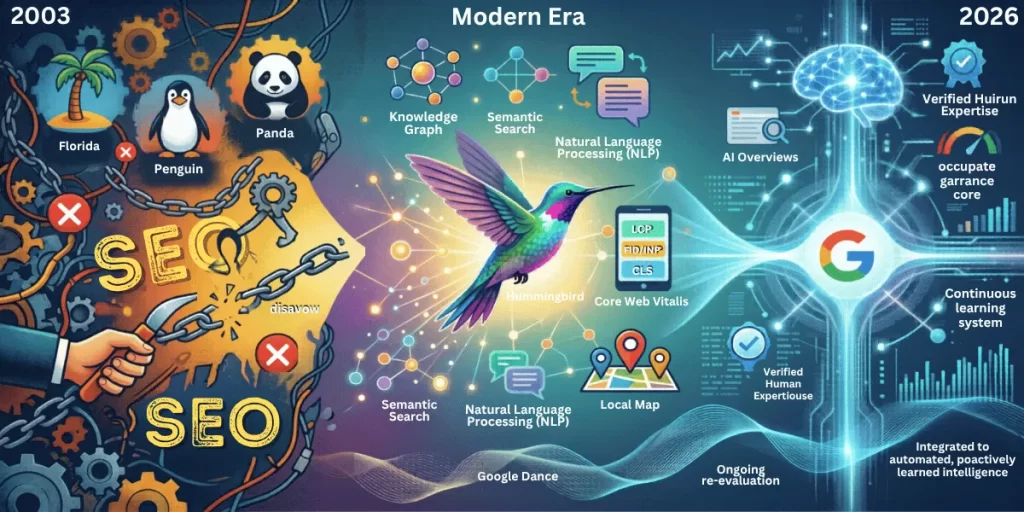
For the longer arc these updates fit into, the complete history of Google algorithm updates covers the pattern going back to 2003.
Confirmed Ranking Updates in Q2 2026
Three confirmed ranking events touched Q2: the tail of the March core update, the May core update, and the June spam update. Nothing else Google announced during the quarter affected rankings directly.
March 2026 Core Update Completion and the April Volatility
The March 2026 core update finished rolling out on April 8, having started on March 27. The Search Status Dashboard records the full rollout at 12 days and 4 hours.
Volatility trackers picked up renewed movement around April 23, well after the rollout closed. Google confirmed nothing during that window. Post-update recalibration, smaller unannounced adjustments, and normal seasonal churn all produce the same signature on a third-party tracker, which is why an unconfirmed spike is a prompt to check your own data rather than a diagnosis.
May 2026 Core Update
The May 2026 core update ran from May 21 to June 2, clocking 11 days and 21 hours on the Search Status Dashboard. That is marginally shorter than March, and close enough to suggest Google has settled into a consistent rollout window for core updates.
Google published no blog post for it and offered no new guidance, repeating the standard line about surfacing content that satisfies searchers. The movement itself was heavier than March, and it split along lines that had less to do with site size than with whether a page was the destination a query called for.
That distinction, along with category-level winners and losers and a recovery process, is covered in full in the breakdown of the May 2026 core update.
Google June 2026 Spam Update
The June 2026 spam update started on June 24 and ran for 2 days and 1 hour, applying globally across all languages.
Google described it as a normal spam update and announced no new spam policies alongside it. That absence is informative. When Google introduces a policy, it publishes a post explaining the change. A dashboard entry with no companion post signals enforcement of rules that already existed.
Search Engine Roundtable reported that this update did not target link spam and did not target the site reputation abuse policy. That matters because a good deal of commentary attributed link-based penalties to it. If your rankings moved between June 24 and 26, link profile is the wrong place to start looking.
For context on pace, the March 2026 spam update finished in 19 hours and 30 minutes, the fastest on record, while the August 2025 spam update took close to four weeks. June sat in the normal range.
Google Policy and Documentation Changes in Q2 2026
Google made more consequential changes to its documentation in Q2 than to its ranking systems. Several of them carry real enforcement or strategic weight.
The Back Button Hijacking Spam Policy
On April 13, Google added back button hijacking to the malicious practices section of its spam policies, with enforcement starting June 15.
Back button hijacking is the practice of manipulating browser history so a visitor pressing back lands somewhere other than where they came from. Search Console began sending warning messages to affected sites during April, naming the June 15 date directly.
The two-month gap between announcement and enforcement was unusually generous. Sites that received a warning and did nothing became eligible for manual actions or automated demotions from mid-June.
Spam Reports Can Now Trigger Manual Actions
On April 14, Google clarified that it may use spam report submissions to take manual action against violations.
This was a meaningful shift. Spam reports had long been treated as training data for automated systems rather than as a route to individual enforcement. Making them actionable changes the incentive around filing them.
Nine days later, on April 23, Google clarified the same guidance again, adding detail on when and why it would act. A second clarification that fast usually means the first one landed badly, and the change did draw criticism about how reports could be used competitively.
“Read More” Deep Links Got Documented Best Practices
On April 20, Google added a section to its snippet documentation explaining how to increase the chance of a “read more” deep link appearing with your content.
These links sit inside a search snippet and jump the visitor straight to the section of your page that answers their query, instead of dropping them at the top. The links themselves are not new. The written guidance is.
Search Engine Land reported the three best practices Google listed:
- Keep the content immediately visible to a human on page load, rather than hidden behind an expandable section or a tabbed interface.
- Avoid using JavaScript to control scroll position on load, such as forcing the visitor back to the top of the page.
- If your pages make history API calls or modify window.location.hash on load, keep the hash fragment in the URL. Removing it breaks the deep linking.
The pattern is familiar. Accordion menus, tabbed content and scroll-hijacking scripts all make a page harder for Google to link into. Long guides with clean, visible section structure stand to gain the most, which is worth checking on any pillar page built with a page builder.
Spam Policies Now Cover AI Overviews and AI Mode
On May 15, Google updated its spam policies to state that they apply to attempts to manipulate generative AI responses in Google Search, not only to ranking manipulation.
Search Engine Land reported the specific wording change: the definition of spam now names attempts to manipulate generative AI responses alongside attempts to rank content highly. AI Overviews and AI Mode both fall under it.
The practical effect is that tactics aimed at getting cited inside an AI answer now sit under the same enforcement framework as web spam, with the same consequences ranging from demotion to removal. Improving content quality and clarifying entity information remain fine. Building pages, links or mentions primarily to force a citation does not.
Google’s New Guide to Optimizing for Generative AI
The same day, Google published a guide on optimizing for generative AI features in Search.
The guide is more direct than most of Google’s documentation. It covers the value of non-commodity content, gives initial guidance on AI agents, and includes a section addressing common AEO and GEO misconceptions by name. Google wrote the counter-argument to a large part of the AI visibility industry, then published guidance three weeks later reinforcing it.
That position lines up with the argument made in this earlier piece on SEO, GEO and AEO: the labels are new, the underlying work is not.
Preferred Sources Expanded Into AI Surfaces
Preferred sources reached all languages Google Search supports on April 30, then became available inside AI Overviews and AI Mode on May 27.
For publishers, this is one of the few levers that lets an audience actively choose to see more of your content. It gets less attention than it deserves because it requires reader action rather than technical work.
Smaller Documentation Changes Worth Knowing
Three further documentation updates landed in Q2. Each matters to a specific situation rather than to everyone.
On June 17, Google updated its site move guidance to cover domain variants, explaining that the Change of Address tool should be used for every subdomain variant including www and non-www. Anyone with a migration planned should read that before starting, because incomplete variant handling is a common reason migrations underperform.
On May 20, the hasAdultConsideration property was added to the merchant listing and product variant documentation, bringing structured data into line with the Merchant Center feed specification. Relevant only if you run product markup.
On June 12, Google published an article explaining how small business owners in Tennessee can get notified when their content is removed or restricted in Search. Narrow in scope, but it shows how Google is handling state-level notification requirements, which is worth watching if similar rules spread.
Two Changes Covered in Detail Elsewhere
FAQ rich results stopped appearing in Google Search on May 7, with the documentation removed on June 15. Why the format still earns its place on a page is covered in Why FAQs still matter.
On June 5, Google published guidance on third-party SEO tools, services and advice, explicitly naming AEO and GEO. That guidance is examined in the May 2026 core update breakdown.
Google I/O 2026 and the Search Box Redesign
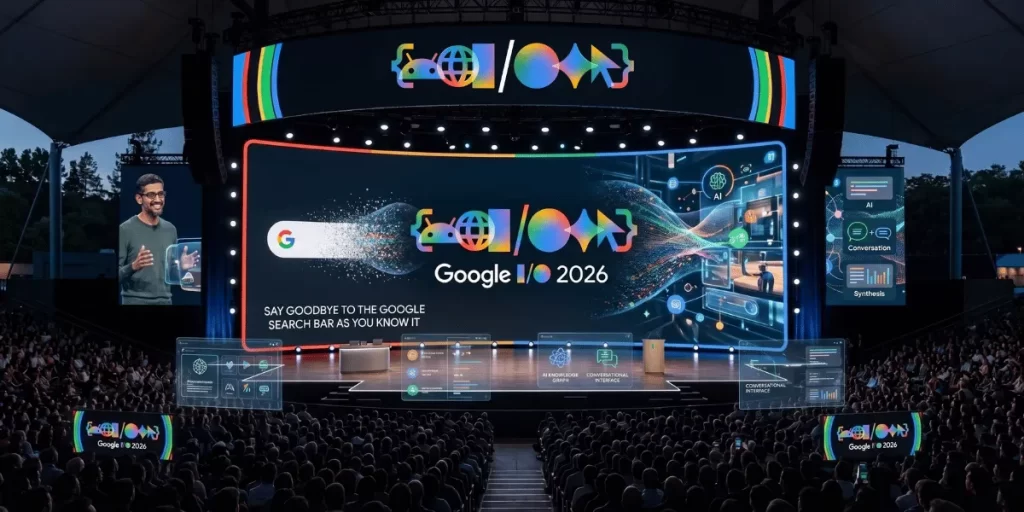
Google I/O ran May 19 to 20 and gave Search more attention than any developer conference in years.
The headline changes were a redesigned search box built for conversational and multimodal input, a new default model powering AI Mode globally, background information agents that monitor topics continuously, and generative interfaces that build layouts on the fly. Google reported AI Mode passing one billion monthly active users and AI Overviews reaching 2.5 billion.
The full breakdown of what the interface change means for search behavior is in Say Goodbye to the Google Search Bar.
What Changed in Search Console Reporting
Search Console changed twice in Q2, once by correcting a year-old error and once by adding a report site owners had asked for since AI Overviews launched. Together they reset what your historical data is worth.
The Impressions Logging Error and Why Your Data Fell
On April 3, Google disclosed that a logging error had caused Search Console to over-report impressions from May 13, 2025 onward.
Search Engine Land reported the disclosure, which arrived as a changelog entry on the Data Anomalies page rather than as a notification or a blog post. Google stated that clicks and other metrics were unaffected and that the issue involved data logging only. Correct logging resumed from April 27, 2026.
The consequence is larger than the disclosure suggested. Search Engine Land later reported John Mueller confirming that the distorted historical data would not be reconstructed. That makes the window from May 13, 2025 to April 27, 2026 permanently unreliable for impression comparisons. Any year-over-year report crossing that period compares a real number against an inflated one.
One nuance sits underneath Google’s wording. Clicks were accurate throughout, as Google said. But click-through rate as displayed in Search Console is derived from impressions, so an inflated denominator made CTR read lower than reality for eleven months.
Teams that set CTR benchmarks during that window built them on a broken figure, even though the clicks feeding it were sound.
Across client accounts, the correction looked exactly like a traffic collapse: a sharp impression drop in late April with clicks holding flat. Sites that had reported impression growth as a win through 2025 had the most awkward conversations. The tell is the shape. A ranking problem moves clicks and impressions together, while this one moved only one of them.
Search Generative AI Performance Reports
On June 3, Google launched dedicated Search Generative AI performance reports in Search Console, isolating impressions from AI Overviews, AI Mode and generative features in Discover.
The reports break down by page, country, device and date. They do not include clicks, click-through rate, average position, or query data. You can see that a page appeared inside an AI surface. You cannot see whether that appearance was worth anything.
Google rolled the reports out to a subset of sites rather than everyone, with UK properties among the first, and data begins from May 18, 2026 with no historical backfill. Alongside them came a toggle that blocks content from AI Overviews, AI Mode and Discover AI features, effective June 17, which Google confirmed carries no penalty in traditional rankings.
Google was also clear that this is a breakout rather than new data. AI impressions were always counted in your overall totals, so aggregate numbers did not change.
What Both Changes Mean for Reporting
Clicks are now the only Search Console metric with unbroken integrity across the past two years. Build reporting around them.
Set April 27, 2026 as a hard baseline in any impression trend and annotate it. Treat the eleven months before it as unusable rather than as context. When the generative AI report reaches your property, export a dated baseline immediately, because there is no backfill to recover later.
Search Behavior Data in Q2 2026
Two datasets published during Q2 describe how people actually searched, and they point in directions that look contradictory until you read what each one measures.
Google’s First AI Mode Usage Numbers
Google published its first analysis of AI Mode usage on May 20, one year after launch.
Search Engine Journal reported the figures: AI Mode surpassing one billion monthly active users globally, queries more than doubling every quarter since launch, the average AI Mode search running three times longer than a traditional search, follow-up queries rising more than 40% monthly in the US, and more than one in six searches using voice, images or video.
The keyword data covers May 2025 to April 2026 and comes from a random sample of Google searches. The behavioral shift it describes is real: people hand AI Mode longer, more conversational problems than they ever typed into a search box.
How Many Searches Still Send a Click
A SparkToro study reported by Search Engine Land in June found that zero-click behavior reached 68% of US Google searches between January and April 2026, up from around 60% in 2024.
The same research found AI Overviews appearing on more than 20% of searches, with click-through rates dropping by nearly 60% when they appear. The study used Similarweb desktop and mobile panel data and excluded searches inside Google’s mobile app, where zero-click behavior may run higher still.
It also found something that sits awkwardly next to Google’s announcement: AI Mode accounted for 0.34% of searches during that period.
Why Adoption Numbers and Query Share Are Not the Same Thing
Both figures are accurate. They measure different things, and most Q2 coverage treated them as if they measured the same thing.
Monthly active users counts anyone who opened AI Mode at least once in a month. Share of query volume counts what proportion of all searches ran through it. A billion people trying a feature occasionally produces a large user number and a small query share at the same time. Google’s own framing supports this reading, since it reported total queries hitting an all-time high rather than classic search declining.
For planning, query share is the number that matters. AI Mode at a fraction of one percent of searches is not where your traffic went during Q2. AI Overviews, appearing on a fifth of searches and cutting clicks when they do, is a far better explanation.
That said, a feature doubling quarterly does not stay at 0.34% for long. The gap between these two numbers is the thing to watch across Q3 and Q4, and it is exactly what the new Search Console reporting will eventually let you measure on your own site.
What the CTR Studies Actually Found
Every study measuring click-through rate under AI Overviews found a decline. None of them agree on the size, because they measure different query types, markets and positions.
Four studies, four answers:
- Ahrefs, 300,000 keywords, December 2025 data: up to 58% lower click-through rate for the top result, revised upward from about 34.5% in its earlier study on March 2025 data.
- Sistrix, German market, February 2026: position one click-through falling from 27% to 11%.
- Amsive, 700,000 keywords: an average decline closer to 15%.
- Pew Research Center, 68,879 tracked searches in 2025: 8% of users clicking an organic result with an AI Overview present against 15% without, a finding Google publicly disputed on methodology.
Note the dates. None of these measures Q2 2026 specifically, which is why they belong here as trend context rather than as findings about this quarter.
Treat the direction as settled and the magnitude as query-dependent. Anyone quoting a single percentage as the effect on your site is quoting a sample that probably looks nothing like your traffic.
What Did Not Happen in Q2 2026
Three claims circulated widely about this quarter that Google’s own record does not support. Each one is worth naming, because in a volatile quarter these are exactly the explanations that get offered for why your traffic moved.
There Was No June 2026 Core Update
Google confirmed no core update in June 2026. The Search Status Dashboard shows the May core update completing on June 2 and the June spam update running June 24 to 26, with nothing confirmed between them.
Despite this, multiple pages published detailed analysis of a “June 2026 Core Update,” complete with percentage impacts by content type. Those percentages describe an event that did not occur.
Information Gain Was Not Confirmed as a Ranking Signal
Google did not announce information gain as a ranking signal in Q2 2026, or at any point in 2026.
The claim appears across a large number of pages, usually stated as fact, and it collapses under basic checking. The sources pushing it disagree on when it supposedly happened, variously attributing it to the February Discover update, to a March core update that started on the wrong date, and to April. None of them cite Google documentation, because none exists.
Information gain is a real concept with real Google patents behind it, and building content around original contribution is sound advice regardless.
The problem is the word “confirmed.” One of the more careful write-ups concedes the point directly, noting Google has never publicly confirmed information gain as a named ranking factor, and that the patent is framed around conversational assistants rather than web results.
Useful strategy and confirmed ranking factor are different categories. Presenting the first as the second is how clients end up making structural decisions on invented evidence.
llms.txt Files Went Almost Entirely Unread
Two independent confirmations arrived on June 15 that llms.txt does almost nothing for search visibility.
Google clarified in its AI optimization guide that llms.txt files are not needed for Google Search and will not affect visibility or rankings positively or negatively, adding that keeping one for other systems is fine.
The same day, Ahrefs published an analysis of roughly 137,000 domains finding that 97% of llms.txt files received zero requests during May 2026. Of about 38,000 valid files, only around 1,100 saw any traffic at all.
The breakdown of that small remainder is the part worth sitting with. Of the requests that did arrive, 96% came from bots. SEO audit tools generated 21% of them, against roughly 1% from the AI retrieval bots linked to ChatGPT and Perplexity. The named fetchers that showed up included Slack’s link preview bot and coding agents, not the search systems the format was built to serve.
Official guidance and independent measurement, published the same day, reaching the same conclusion. That is about as clear as evidence gets in this field.
How to Check a Claim Against Google’s Own Record
Google’s June 5 guidance provides the test. It states plainly that third-party tools have no access to internal ranking data and cannot guarantee performance, and recommends evaluating any advice against official documentation.
Two sources settle most disputes. The Search Status Dashboard lists every confirmed ranking update with exact start and end times. The Search Central documentation changelog lists every documentation change with its date and Google’s stated reason. If a claim about what Google “now does” cannot be traced to one of those, it is someone’s interpretation, and it should be labeled as one.
What Q2 2026 Means for Your Site
The right response to this quarter depends less on what changed at Google than on what kind of site you run.
Affiliate and Content Sites
The reporting changes hit hardest here, because impression growth has often been the metric used to argue that content investment is working. That argument no longer holds for anything before late April.
Rebuild your reporting on clicks and conversions. If a section of the site exists mainly to capture search volume rather than to serve a reader, the direction of the past two core updates has been consistent enough to treat that as exposure rather than an asset.
Local and Service Businesses
Very little in Q2 requires action from a well-run local site. No policy change targets local business content, and the spam updates address practices most local sites never use.
The item worth attention is the back button hijacking policy, which occasionally catches sites using aggressive third-party booking widgets or lead capture scripts. Check what your plugins do to browser history.
B2B and SaaS
The AI Mode behavioral data matters most here, because longer, more conversational queries map closely to how software buyers research.
Pages built around a working product or tool have been the most stable category through both 2026 core updates. Content sections attached to those sites are still evaluated as content and follow the same rules as everyone else’s. When the generative AI report reaches your property, compare which pages appear in AI surfaces against which pages earn organic clicks, because the two lists are often different.
Sixty Days On: What Held Up
Two months after the quarter closed, some of Q2’s conclusions look better than others.
The Search Status Dashboard confirms no core update since May, which makes the May rollout the most recent broad recalibration and its lessons still current. Google has run one further ranking event since the quarter closed: the August 2026 spam update, which started on August 18 and took 2 days and 16 hours.
That is the second spam update in under two months, against no core update in three. Anyone still watching only for core updates is watching the wrong half of the dashboard.
The generative AI performance reports still show impressions without clicks, so the measurement gap Q2 opened has not closed. Nothing has contradicted the llms.txt findings.
The Information Gain claim, meanwhile, is still circulating and still uncited. Some of the pages making it now rank well for it, which is a reminder that ranking and accuracy are separate properties.
One prediction reaches its deadline about now. Gartner forecast in February 2024 that search engine volume would fall 25% by 2026, a figure quoted constantly across the past two years. On the I/O stage in May, Google said queries had reached an all-time high the previous quarter. That forecast is no longer a projection to cite, it is a claim to test, and on the available evidence it has not landed.
The Q3 review will pick up from here.
Questions About Q2 2026 Google Updates
How many Google updates were there in Q2 2026?
Three confirmed ranking events: the March core update completing on April 8, the May core update running May 21 to June 2, and the June spam update running June 24 to 26. Google also made several documentation and policy changes that did not affect rankings directly.
Was there a June 2026 core update?
No. Google confirmed no core update in June 2026. The Search Status Dashboard shows the May core update finishing on June 2 and the June spam update running June 24 to 26, with nothing else confirmed. Analysis describing a “June 2026 core update” is describing an event that did not happen.
Why did my Search Console impressions drop in April 2026?
Almost certainly because Google fixed a logging error that had been inflating impressions since May 13, 2025. Google disclosed this on April 3 and corrected logging by April 27. Clicks were unaffected, so if impressions fell while clicks stayed flat, this is the reason rather than a ranking change.
Do I need an llms.txt file for Google Search?
No. Google clarified on June 15 that llms.txt files are not needed for Google Search and have no positive or negative effect on visibility or rankings. Ahrefs found the same week that 97% of these files received no requests at all during May 2026. Keeping one is harmless if other systems use it.
Does the June 2026 spam update target link building?
No. Search Engine Roundtable reported that this update did not target link spam or the site reputation abuse policy. If your rankings moved during the June 24 to 26 window, your link profile is unlikely to be the cause.
Which Q2 2026 change matters most for a small site?
The Search Console impressions correction, because it affects how you read your own data rather than how Google ranks you. Any performance comparison spanning May 2025 to April 2026 is measuring against inflated numbers, and no amount of SEO work fixes a broken baseline.
Q2 2026 Reference Timeline
Every confirmed change from April to June 2026, with its source. This covers all fifteen entries in Google’s documentation changelog for the quarter, plus the ranking events from the Search Status Dashboard, the Search Console reporting corrections, and I/O.
April 2026
- April 3: Google disclosed a Search Console impressions logging error
- April 8: March 2026 core update finished rolling out
- April 13: Back button hijacking added to the spam policies
- April 14: Spam reports confirmed as grounds for manual action
- April 20: “Read more” deep links documented
- April 23: Spam report guidance clarified again
- April 27: Impression logging corrected from this date forward
- April 30: Preferred sources expanded to all languages
May 2026
- May 7: FAQ rich results stopped appearing
- May 15: Spam policies extended to generative AI responses
- May 15: New guide on optimizing for generative AI published
- May 19 to 20: Google I/O 2026
- May 20: hasAdultConsideration added to product structured data
- May 21: May 2026 core update began
- May 27: Preferred sources reached AI Mode and AI Overviews
June 2026
- June 2: May 2026 core update finished rolling out
- June 3: Search Generative AI performance reports launched
- June 5: Guidance on third-party SEO tools published
- June 12: Article published on Search notifications for Tennessee small businesses
- June 15: Back button hijacking enforcement began
- June 15: llms.txt guidance clarified
- June 17: AI feature opt-out toggle took effect
- June 17: Site move guidance extended to domain variants
- June 24 to 26: June 2026 spam update
Further Reading
- Google Algorithm Updates: A Complete History
- Google May 2026 Core Update: What Changed and How to Recover
- Say Goodbye to the Google Search Bar as You Know It
- Why FAQs Still Matter Even After Google Removed FAQ Rich Results
- SEO, GEO and AEO
- Google Search Status Dashboard
- Google Search Central documentation updates
- Google’s guidance on third-party SEO tools and advice
- Optimizing for generative AI search
- Google’s spam policies
About the Author

Ashan Kusalanka
SEO Consultant with 10+ years of experience helping local and global businesses strengthen their digital presence. I design strategies that improve visibility, build authority, and drive sustainable growth.