Table of Contents
ToggleTen years in search teach you one thing above everything else. The industry never kills an idea. It renames it.
I’ve watched this pattern repeat enough times to recognise it immediately. A genuine shift in technology creates real uncertainty. Smart people write about it. Marketers package it. Agencies build service lines around it. And somewhere along the way, the original idea gets buried under a new acronym and a premium price tag.
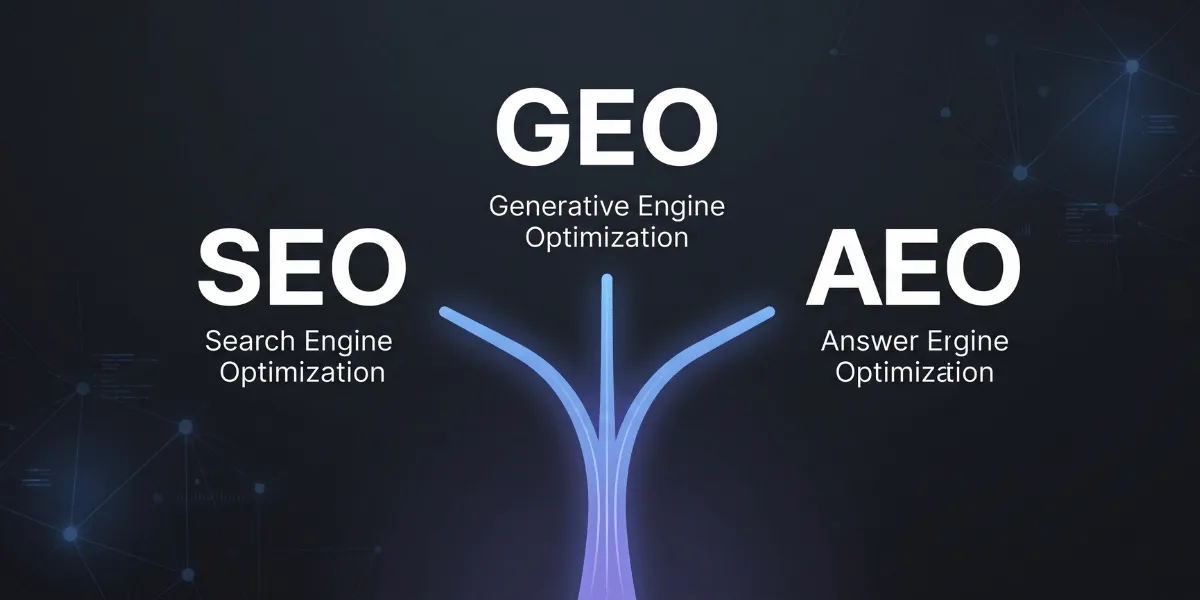
That’s exactly what happened with SEO, GEO, and AEO.
Generative engine optimisation, answer engine optimisation, and large language model optimisation. Three terms that arrived within months of each other, each positioned as the evolution of what came before. LinkedIn is filled with posts declaring the SEO era is finished. Courses appeared overnight. Agencies launched “AI-optimised” content packages at rates that assumed the work was new.
I read through most of it. And when I looked past the terminology and into the actual tactics being recommended, one thing stood out consistently. Almost all of it was SEO. Structured content, E-E-A-T signals, topical authority, user experience. The fundamentals experienced SEOs have applied for years, repackaged in language that makes them sound like something else entirely.
This article is about what’s genuinely changed, what hasn’t, and how to handle it without starting from scratch or paying twice for the same work.
Search Has Changed. The Reason People Search Hasn't.
The way search results look today is genuinely different from five years ago. That part is not an exaggeration.
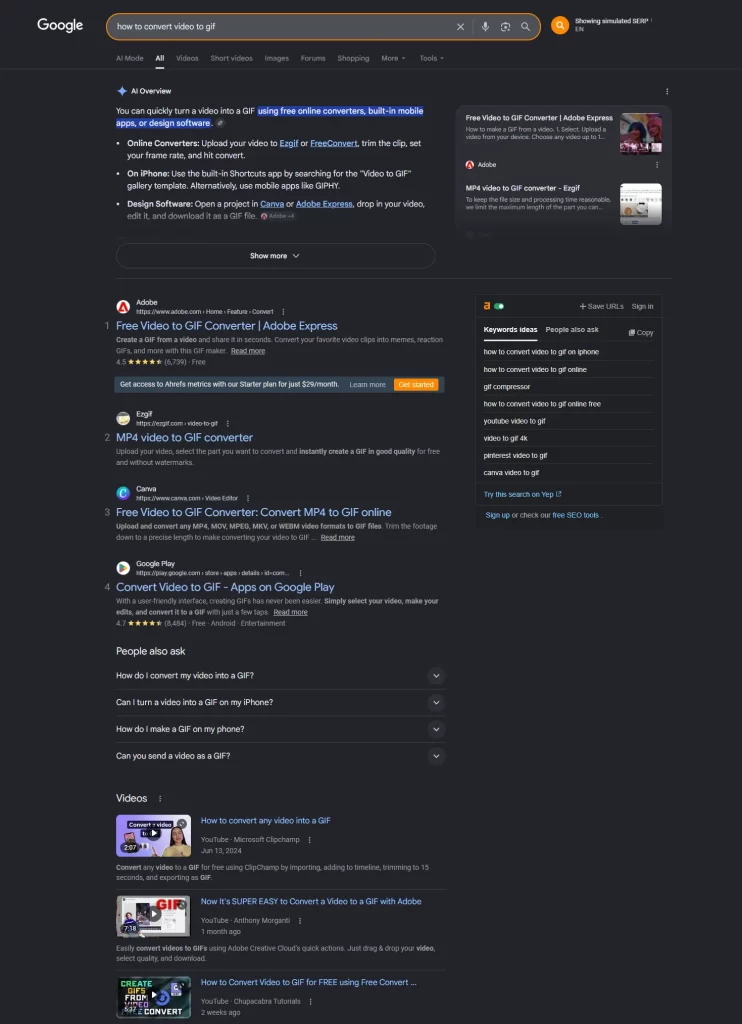
Take a query like “how to convert video to GIF.” A few years back, the results page was a mix of articles walking through the steps, maybe a tool listing or two. Now, Google’s AI Overview handles the explanation entirely. Tool-based websites like freeconvert.com and iLovePDF appear as direct options beneath it. Video results surface for users who want a visual walkthrough. The article format that used to dominate this type of query has largely disappeared from the first page.
That shift is real. Article-heavy sites built on AdSense revenue or affiliate links have taken measurable traffic losses as AI Overviews absorb the informational layer. Meanwhile, tool-based websites are seeing the opposite. When AI handles the “how,” the tool that does the “what” gets featured directly in results.
But here’s the part that gets lost in the noise. This is a change in how results are delivered, not in why people are searching.
People search because they have a problem and want a solution. A question and want a clear answer. An intent they want to act on. That has not changed. What changed is which content format earns visibility for which query type. And understanding that distinction matters far more than learning a new acronym.
AI Overviews, AI Mode, ChatGPT Search, Perplexity, and Microsoft Copilot are all now part of where search happens. According to Pew Research data from early 2026, 31% of US adults interact with AI multiple times daily, with 38% of 18 to 29 year olds now using AI tools as their primary way of accessing information. ChatGPT processes roughly 2.5 billion prompts per day, and around 65% of those qualify as search queries.
Search behaviour has fragmented across platforms. That’s the reality. But behind every one of those platforms, the same core evaluation is happening: is this source credible, is this content genuinely useful, and can the answer be trusted?
That question is SEO. It always has been.
The Delivery Mechanism Changed. The Trust Signals Didn't.
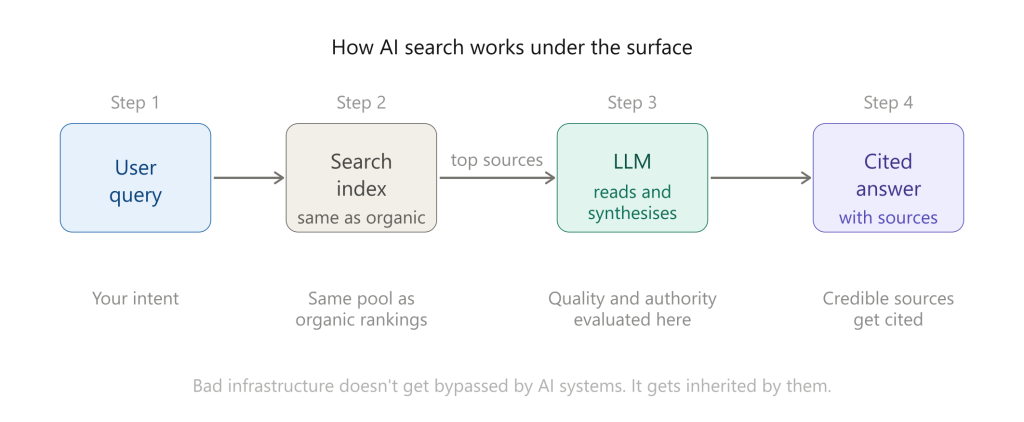
To understand why the fundamentals still apply, it helps to know how AI-powered search actually works under the surface.
Most generative search systems, including Google’s AI Overviews, operate through a process called Retrieval Augmented Generation, or RAG. The system pulls relevant documents from a search index, a large language model summarises across those sources, and a response is generated with inline citations. For Google specifically, that index is the same traditional search index that organic rankings have always drawn from.
This is not a minor technical detail. It means Google’s AI features are reading from the same pool of content as traditional search. A page that isn’t crawlable, hasn’t been indexed, or hasn’t earned authority signals won’t appear in AI Overviews because it doesn’t exist in the index that feeds them. Bad infrastructure doesn’t get bypassed by AI systems. It gets inherited by them.
Google confirmed this directly in its May 2026 AI optimisation guide published on Google Search Central. The documentation states that its AI features are rooted in core search ranking and quality systems. The guide goes further, naming AEO and GEO specifically and stating that from Google Search’s perspective, optimising for generative AI search is still SEO.
The trust signals that move a page up traditional rankings, quality content, strong E-E-A-T signals, technical accessibility, authoritative backlinks, and genuine topical authority, are the same signals that determine whether content gets surfaced in an AI-generated response.
Different delivery. Same criteria.
What SEO, AEO and GEO Actually Mean (Without the Hype)
Before making the case that these disciplines are more connected than they appear, it’s worth being precise about what each term actually describes. The definitions themselves are not complicated. The problem is they’ve been explained so many times alongside competing agendas that the plain meaning has gotten buried.
So here it is, without the sales pitch.
SEO - The Foundation Everything Else Is Built On
Search engine optimisation is the practice of making your website and its content easy for search engines to find, understand, and rank. That covers three broad areas that work together.
Technical SEO covers the infrastructure. Crawlability, indexability, page speed, mobile experience, Core Web Vitals, canonical tags, XML sitemaps, structured data. This is the floor. If a search engine can’t properly access and process your pages, nothing else matters.
On-page SEO covers what’s on each page. Content quality, heading structure, keyword intent, internal linking, and how well the page serves the person who lands on it. Not just whether keywords appear, but whether the content actually answers the question behind the query.
Off-page SEO covers authority signals that exist outside your site. Backlinks from credible sources, brand mentions, digital PR, and the overall footprint your brand has across the web.
SEO has been declared dead at least four times since I started in this industry. It hasn’t died once. It’s changed shape, but the core problem it solves remains constant: getting your content in front of people who are looking for it.
AEO - Structuring Content to Own the Answer
Answer engine optimisation focuses on structuring content so that AI-powered search features can extract and surface it as a direct answer. Think Google AI Overviews, featured snippets, People Also Ask boxes, Bing Copilot responses, and voice search results.
The shift here is about format as much as content. Answer engines don’t rank pages in a list and leave the user to browse. They extract a specific passage, a clear definition, a direct answer to a question, and present it without the user needing to visit the source.
To show up in those extractions, content needs to lead with the answer. A question-based heading followed immediately by a concise, standalone response of around 40 to 60 words, then deeper explanation beneath. That structure makes it straightforward for any AI system to identify what’s being answered and pull the relevant section.
The underlying requirement, though, is not structural. It’s accuracy and clarity. A well-written, factually reliable answer to a specific question is what earns that placement. The structure just makes it easier for the system to find.
Good SEOs were already doing this. Optimising for featured snippets has been part of standard practice since at least 2016. AEO formalised the concept under a new name.
GEO - Getting LLMs to Cite You
Generative engine optimisation is about increasing the likelihood that large language models like ChatGPT, Gemini, Perplexity, and Claude reference your content or brand when generating answers.
This is where the conversation gets more interesting, because GEO does have a genuine distinction from traditional SEO. It’s not a completely separate discipline, but the scope is wider.
Traditional SEO is primarily concerned with your own website: your pages, your content, your technical setup. GEO extends the frame to everywhere your brand exists across the web. LLMs build their understanding of a topic by pulling from training data and, for real-time responses, from retrieval systems that scan the broader web. Your brand’s presence on third-party platforms matters here in a way it hasn’t before.
Unlinked brand mentions are the clearest example. In traditional SEO, a mention of your brand on another website carries almost no direct value unless it includes a link. For LLMs building a picture of who the authoritative sources are on a given topic, consistent brand mentions across credible third-party sources are a meaningful signal, link or no link.
The Princeton University GEO study, published by researchers from Princeton, Georgia Tech, and the Allen Institute for AI, tested this across 10,000 queries through a benchmark called GEO-bench. The findings are worth knowing in detail, because most articles only quote the headline number.
Including citations, expert quotes, and data-backed statistics boosted source visibility in generative engine responses by over 40%. That part gets cited widely. What doesn’t get mentioned as often is what the study found didn’t work.
A persuasive or authoritative tone alone produced no significant improvement. The researchers concluded that generative engines are already robust to tone manipulation, pointing instead to the quality and credibility of the content itself. Keyword stuffing produced little to no improvement in LLM visibility. And the effectiveness of any GEO method was domain-dependent. What worked for a finance query didn’t automatically transfer to a health query or a technology query.
Read those findings alongside the popular GEO advice circulating online and a gap becomes clear. Much of what’s being sold as GEO strategy either doesn’t move the needle, according to the research, or is just SEO fundamentals described differently.
LLMO, AIO, Search Everywhere - The Same Conversation Again
Large language model optimisation, AI optimisation, search everywhere optimisation. These are umbrella terms for the same underlying challenge: staying visible as the surfaces where people discover information keep expanding.
They’re worth knowing so you can follow the conversation in your industry. They’re not worth building separate strategies around.
Each of these terms essentially describes the practice of making your content credible, clear, and accessible across multiple platforms including traditional search engines, AI-generated answers, voice results, and whatever emerges next. That is not a new goal. The channels have multiplied. The objective hasn’t.
The SEO industry has a long history of creating terminology that makes existing work sound like a new service category. LLMO and AIO are the latest version of that. If someone quotes you a fee specifically to optimise your content for LLMs without starting from your technical foundation, content quality, and authority signals, ask them what exactly they’d be doing differently.
Most of the time, the answer confirms what you already suspected.
If you want the clearest possible answer to what actually matters for AI search visibility, you don’t need an agency whitepaper. Google published it themselves.
What Google Actually Said (And Most People Ignored)
In May 2026, Google published a dedicated documentation page on Google Search Central titled “Optimising your website for generative AI features on Google Search.” It expanded on earlier guidance and addressed the AEO and GEO conversation directly.
Most coverage summarised it in a headline and moved on. The actual content of the guide is more useful than the headlines suggest, particularly because Google names specific tactics by name and tells site owners which ones to skip. That level of directness is unusual from Google, and it deserves more attention than it received.
So here it is, without the sales pitch.
Google Calls AEO and GEO “Still SEO” - In Its Own Words
The guide opens by confirming that its generative AI features, including AI Overviews and AI Mode, are rooted in the same core search ranking and quality systems that power traditional organic results. The mechanism feeding those features is Retrieval Augmented Generation. Google’s AI systems retrieve content from the standard search index, pass it through a language model, and generate a response with inline citations.
That architecture matters because it means there is no separate pipeline to optimise for. The same index. The same quality signals. The same authority evaluation.
On the terminology question, Google is direct. The guide defines AEO as answer engine optimisation and GEO as generative engine optimisation, then states plainly that from Google Search’s perspective, optimising for generative AI search is optimising for the search experience, and therefore still SEO.
That’s not an interpretation or a reading between the lines. Google put it in its own documentation.
Danny Sullivan, Google’s Search Liaison, made similar points in January 2026 after speaking with Google engineers about how AI features process content. His comments on content chunking, which will be covered shortly, were consistent with the formal guidance that followed.
The guide also addresses what it calls agentic experiences, an emerging area involving browser-based AI agents that interact with websites on behalf of users. Google frames this as forward-looking and optional, something to consider if it’s relevant to your business and you have extra time. That framing matters. Google itself is not treating agent optimisation as urgent for most site owners. Neither should you.
What Google Says You Can Stop Worrying About
This is the most practically useful part of the guide, and it received far less coverage than it deserved.
Google names several tactics directly and tells site owners they are not required for generative AI search. Given that a growing number of agencies are charging specifically to implement these tactics, having Google’s own documentation on record is significant.
llms.txt files. Google states clearly that site owners do not need to create machine-readable files, AI text files, special markup, or Markdown versions of content to appear in generative AI search. Google may discover and index file types beyond HTML, but those files receive no special treatment in its AI features.
Content chunking. The guide says there is no requirement to break content into small, isolated pieces for AI systems. Google’s systems can understand multiple topics on a single page and surface the relevant section to users. Danny Sullivan reinforced this in January 2026, noting that engineers had specifically recommended against chunking content.
AI-specific schema and special markup. Structured data remains useful for helping Google understand content context, but there is no special schema category that improves AI visibility. Standard structured data practices apply. Nothing additional is needed.
AI-specific content rewriting. Rewriting existing content to make it sound more “AI-friendly” without improving the underlying quality is not something Google’s guide recommends. Quality and helpfulness are what the evaluation systems look for, not surface-level formatting changes.
Inauthentic brand mentions. The guide specifically flags manufactured or paid mentions designed to inflate brand signals as something Google works to identify and discount. This is the GEO equivalent of link schemes, and Google treats it the same way.
If you’ve been quoted for any of these services, this documentation is a useful reference point.
What Google Says Actually Works
The positive guidance in the document is considerably less surprising than the list of what to ignore. That’s the point.
Google recommends creating helpful, reliable, people-first content. It recommends strong E-E-A-T signals: demonstrating experience, expertise, authoritativeness, and trustworthiness through the content itself, not through surface claims. It recommends keeping content technically accessible, meaning properly crawlable, indexable, and structured so that its systems can process and understand it without friction.
It recommends maintaining accurate and consistent information about your brand across the web. It recommends building genuine authority through credible backlinks and third-party references. It recommends updating content regularly to keep it accurate and relevant.
Every single one of these recommendations existed in SEO guidance before GEO was a named concept. Google’s closing note in the guide states that plenty of content performs well in Search, including generative AI features, without any overt SEO at all. The implication is clear: content that genuinely serves people tends to get found. The fundamentals are not a workaround for the AI era. They’re the reason some sites are holding up through it.
Where GEO Is Genuinely Different From SEO
Making the case that GEO and SEO share the same foundation doesn’t mean the two are identical in every respect. There are real differences, and being precise about them is more useful than either dismissing GEO entirely or treating it as a revolution.
The differences are specific. They’re also narrower than most of the conversation around GEO suggests.
Unlinked Brand Mentions Now Matter More
In traditional SEO, a brand mention without a hyperlink carries almost no direct ranking value. Search engines built their authority systems around links as explicit signals of endorsement. An article that references your brand but doesn’t link to you contributes very little to your organic visibility.
For large language models, this calculus shifts considerably.
LLMs develop their understanding of which brands are authoritative on a given topic by processing large volumes of text from across the web. When your brand is mentioned consistently, in relevant contexts, across credible third-party sources, that pattern becomes part of how the model associates your name with a subject area. A link is not required for that association to form.
This means platforms you may have treated as secondary, Reddit discussions, Quora answers, niche industry forums, trade publications, podcast transcripts, and PR placements, now carry a form of value that traditional SEO metrics don’t fully capture. Your presence on those platforms contributes to the picture an LLM builds of your brand’s authority.
This is the most meaningful practical difference between GEO and traditional SEO. It doesn’t require a new strategy. It requires an expanded view of where your brand needs to show up and how consistently it does so.
Each AI Platform Behaves Differently
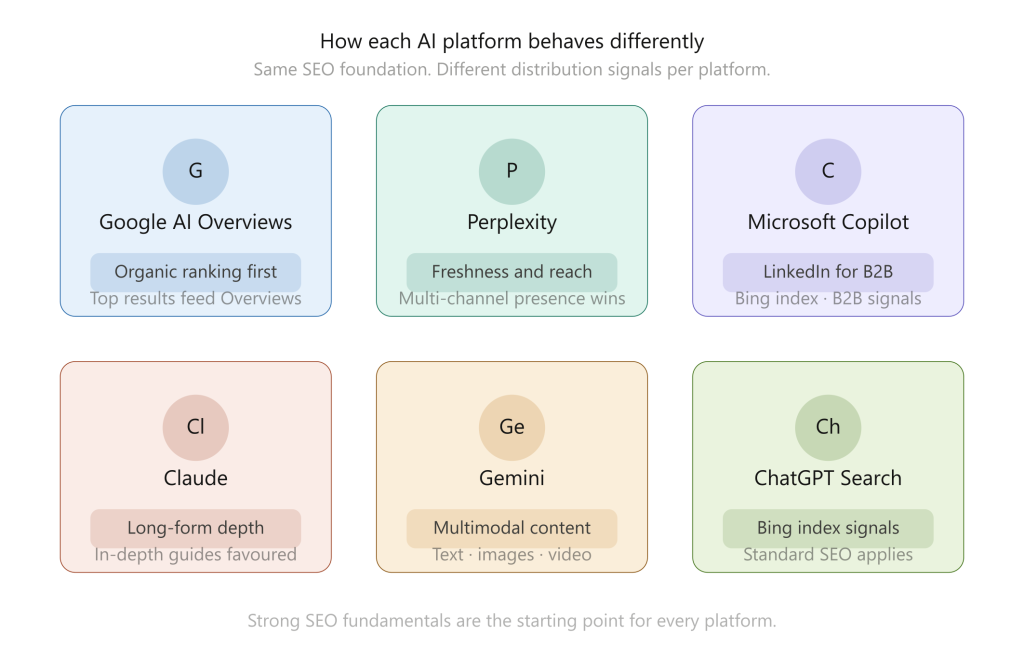
Treating AI-powered search as a single monolithic channel is one of the more common mistakes in how GEO gets discussed. These platforms are built differently, pull from different sources, and weight different signals.
Understanding those differences helps with content and distribution decisions.
Google AI Overviews and AI Mode draw primarily from Google’s traditional search index. Ranking well organically for a topic is still the most reliable path to appearing in AI Overviews for that topic. If your content isn’t in the top results, it’s unlikely to be in the AI-generated summary either. SEO fundamentals come first.
Perplexity places greater weight on content freshness and multi-channel brand presence. Appearing in recent publications, industry news, and authoritative third-party sources increases the likelihood of being surfaced. A single well-optimised website without an external footprint is less competitive here than on Google.
Microsoft Copilot, built on the Bing index, shows a notable lean toward LinkedIn for B2B queries. If your target audience operates in a professional context and you have a thin LinkedIn presence, Copilot results will reflect that gap.
Claude tends to favour long-form, comprehensive, well-structured content. Guides that cover a topic with genuine depth and clear organisation perform better here than shorter, fragmented pieces.
Gemini processes multimodal content, meaning text, images, and video all contribute to how it evaluates and surfaces sources. A site that publishes only text and ignores visual or video content has a narrower footprint in Gemini’s evaluation.
ChatGPT Search uses the Bing index as its retrieval layer, confirmed by OpenAI. That means Bing’s ranking signals apply, and traditional technical SEO practices transfer directly.
The practical takeaway is straightforward. Strong SEO fundamentals remain the starting point for all of these platforms. What changes between them is where you distribute your content and which additional channels you invest in.
What the Princeton Research Actually Found
The Princeton GEO study is cited in almost every article on this topic. It’s cited selectively in most of them.
The research, conducted by a team from Princeton University, Georgia Tech, and the Allen Institute for AI, tested GEO methods across a benchmark of 10,000 queries spanning multiple domains. The headline finding, that including citations, expert quotes, and data-backed statistics can boost source visibility in generative engine responses by over 40%, is accurate and worth taking seriously.
But three other findings from the same study rarely appear in the coverage, and they’re arguably more useful.
First, writing in a more persuasive or authoritative tone produced no significant improvement in LLM visibility. The researchers concluded that generative engines are already robust to tone manipulation. The implication is direct: writing that sounds confident but lacks substance doesn’t earn citations. Credibility has to be real.
Second, keyword stuffing produced little to no performance improvement for generative engine visibility. This is a direct contrast to older SEO tactics and confirms what Google has been saying about quality for years. LLMs are not pattern-matching on keyword frequency the way early search algorithms did.
Third, the effectiveness of any GEO method was domain-dependent. A tactic that improved visibility for financial content didn’t automatically transfer to health or technology queries. There is no universal GEO formula that works across every niche.
Put those findings together and the picture becomes clearer. The tactics that actually move the needle in generative engine visibility, specific citations, verifiable data, genuine expert perspective, are the same things that build content credibility in traditional search. The tactics that don’t work, inflated tone, keyword density plays, generic optimisation checklists applied regardless of context, are the same ones that have been losing effectiveness in SEO for years.
The research doesn’t validate GEO as a separate discipline. It validates quality as the consistent underlying requirement across both traditional and generative search.
How We Got Here? Three Waves That Changed Search
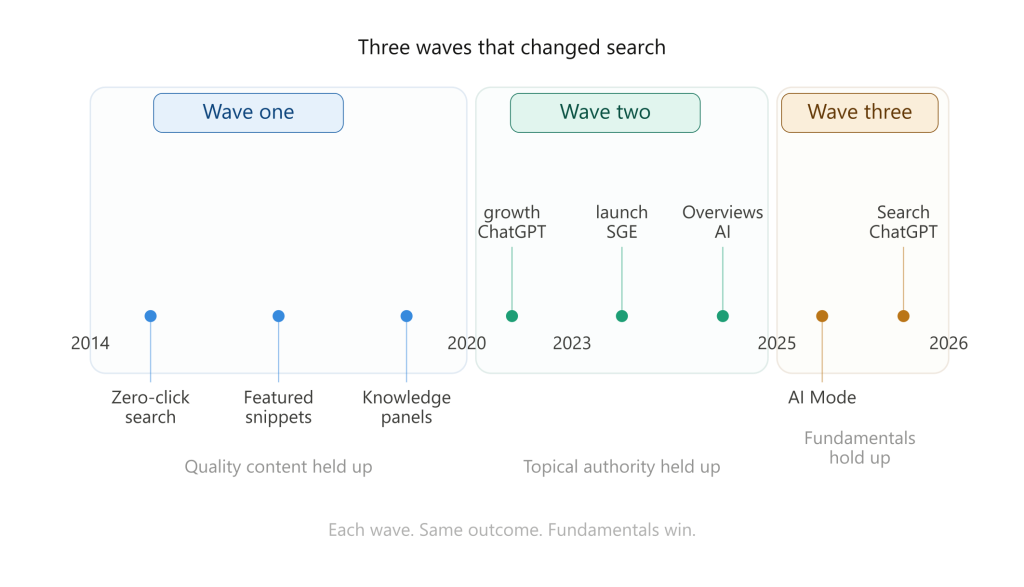
The current conversation about SEO, GEO, and AEO didn’t appear from nowhere. It’s the product of a search landscape that has shifted meaningfully three times in the last decade, each time producing the same cycle: genuine disruption, industry panic, rebranding of existing practices, and eventual stabilisation around the same underlying principles.
Having worked through all three of these shifts, the pattern is recognisable. Understanding it helps separate what’s actually new from what’s familiar anxiety in different clothing.
The differences are specific. They’re also narrower than most of the conversation around GEO suggests.
Wave One - Zero-Click Search (2014 to 2020)
The first wave arrived quietly and then accelerated fast.
Google began answering questions directly on the results page. Featured snippets appeared at position zero, pulling content from ranking pages and displaying it without requiring a click. Knowledge Panels consolidated brand and entity information into structured cards on the right side of the SERP. The Local Pack dominated map-based queries, reducing a full page of local results to three visible options above the fold.
For informational queries especially, organic click-through rates started dropping. Sites that had built traffic models around people clicking through to read an article watched their numbers shift as Google started providing the answer before the click happened.
The SEO industry declared this the death of traditional search. New frameworks appeared for “position zero optimisation.” Agencies added featured snippet targeting to their service lists.
What actually happened was more straightforward. Sites with clear, well-structured, genuinely helpful content tended to appear in those featured positions. The technical work of making content extractable, heading structure, concise answers, logical page organisation, was the same technical work good SEOs were already doing. The channel behaviour changed. The content requirements didn’t.
Wave Two - AI Overviews and the Answer Layer (2023 to 2025)
The second wave felt more dramatic because it arrived faster and at a larger scale.
Google launched its Search Generative Experience in 2023 as an experimental feature, then rolled AI Overviews into mainstream search results through 2024 and 2025. ChatGPT, which launched publicly in November 2022, accumulated users at a rate no previous technology product had matched. Perplexity grew as an alternative search interface that returned cited answers rather than links. The search landscape, which had been largely stable for years, started fragmenting visibly.
The traffic data followed. AI Overviews reduced click-through rates for top-ranking content by 58% for the query types they covered. Article-heavy websites built on advertising or affiliate revenue felt this the most. The informational content that had generated reliable traffic for years was now being summarised at the top of the page.
But the sites that held up through this period had something in common. They had built genuine topical authority over time. They had invested in content quality rather than content volume. They had technical foundations that made their pages accessible and credible to Google’s systems. When AI Overviews sourced content for their summaries, those sites appeared as references.
The sites built on thin content, high-volume production, and keyword matching without depth didn’t hold. Not because the algorithm changed against them specifically, but because the evaluation standard became harder to pass when AI systems needed to determine which sources were actually worth citing.
The pattern from wave one repeated. Disruption, panic, rebranding of existing practices, then stabilisation around quality fundamentals.
Wave Three - AI-First Search and Where Things Stand Now (2025 to 2026)
The third wave is the one we’re in, and it’s the most significant in terms of how people actually interact with information.
Google’s AI Mode moved beyond AI Overviews into a more fully generative search experience. ChatGPT Search launched with Bing’s index as its retrieval layer, making it a direct competitor to Google for a growing portion of search queries. Perplexity established itself as a primary research tool for a specific and influential segment of users. According to Pew Research data from early 2026, 38% of adults aged 18 to 29 now use AI tools as their primary method for accessing information.
The SERP for many queries no longer looks like a ranked list of ten links. It looks like a synthesised answer with supporting sources, tool recommendations where relevant, video content where the format fits, and traditional organic results below. The surface has changed substantially.
What this wave introduced that the previous two didn’t is a genuine shift in which content formats win for which query types. A how-to article competing against an AI Overview, a video walkthrough, and a directly listed tool is in a harder position than it was two years ago. The question to ask before producing any content is no longer just “can this rank?” It’s “what does the current SERP for this query actually look like, and is an article the right format for it?”
Tool-based content, original data, personal experience, video, and interactive resources compete with AI in a way that articles summarising publicly available information do not. AI can write a how-to article. It cannot replicate a tool someone uses, a dataset someone collected, or an observation from ten years of hands-on client work.
That’s the most practically important thing wave three has changed. It hasn’t changed what quality looks like. It’s raised the cost of mediocre content and increased the premium on content that brings something genuinely new to the table.
The sites that will hold up through this wave are the same profile as the ones that held through the previous two. Solid technical foundations, real topical authority, content that serves people rather than algorithms, and a brand presence that extends beyond a single website.
The Fundamentals That Have Never Changed
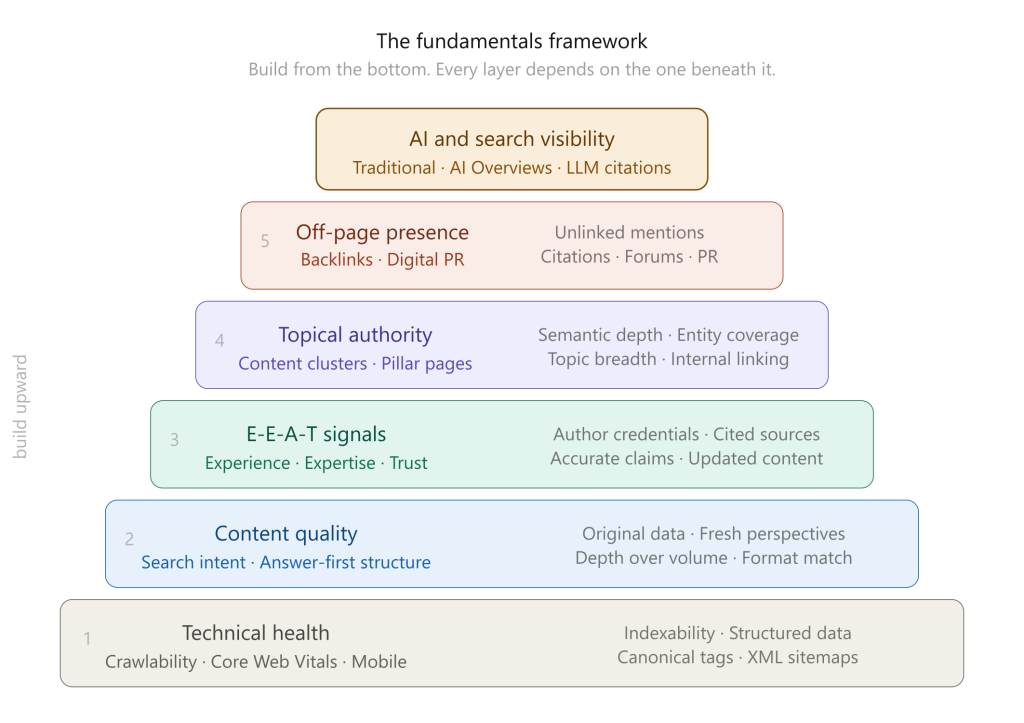
Knowing the pattern helps. Acting on it is a different question.
Every client conversation I’ve had since AI Overviews became mainstream starts the same way. The terminology changes depending on what they’ve been reading. Some come in asking about GEO. Some ask why their competitor is appearing in AI answers. Some have been told they need a new strategy entirely.
The diagnostic process looks the same regardless of how the question arrives. Technical foundation first. Content quality second. Authority signals third. Over ten years of working with clients across different industries, markets, and budget ranges, that order has never needed to change.
The fundamentals aren’t a consolation prize for people who haven’t caught up with AI search. They’re the reason some sites are gaining visibility while others are losing it.
Technical Health Is Still the Floor
No content strategy, regardless of how well it’s executed, compensates for a site that search engines and AI systems can’t properly access.
Google’s AI features pull from the same index as organic results. That index is built from what Googlebot can crawl and process. A page blocked in robots.txt, sitting behind a JavaScript rendering issue, or returning a soft 404 is not a candidate for AI Overviews. The AI doesn’t find a workaround. It simply moves to the next available source.
The technical checklist hasn’t changed in principle, even if the specifics evolve. Crawlability and indexability remain the starting point. Core Web Vitals, specifically Largest Contentful Paint, Cumulative Layout Shift, and Interaction to Next Paint, feed into how Google evaluates page experience. Mobile-first indexing means the mobile version of your site is what Google actually evaluates.
Canonical tags, internal link depth, duplicate content, and XML sitemaps all affect how efficiently a site gets processed.
Structured data sits in an interesting position right now. Google’s AI guide confirms it doesn’t need special schema for AI features. Standard structured data remains worthwhile because it helps Google understand content context clearly, which indirectly benefits how that content gets processed and surfaced. The purpose hasn’t changed. The expectations around it have been recalibrated.
When I start a client audit, this is always the first stop. Not because it’s the most exciting part of the work, but because everything else depends on it being solid. A technically compromised site with excellent content will underperform a technically clean site with average content, every time.
Content That Actually Helps People Gets Cited
This is the section where “write good content” risks sounding too simple. But the specifics matter, and they’re worth being precise about.
The content that appears in AI-generated answers shares consistent characteristics. It answers a specific question directly. It doesn’t bury the answer under three paragraphs of introduction. It’s factually accurate and cites or references sources that can be verified. It covers the topic with enough depth to be genuinely useful, without padding for the sake of word count.
The Princeton research is instructive here. The tactics that actually improved LLM citation rates were citations to credible sources, inclusion of verifiable statistics, and expert perspective. These aren’t formatting tricks. They’re markers of content that took real effort to produce and can be trusted as a reference.
What this means practically is that fresh content needs to be genuinely fresh. Not fresh in the sense of publishing the same information with updated date stamps. Fresh in the sense of bringing something to the table that doesn’t already exist in a dozen other places. Original data from a client project. An observation from direct experience with a specific platform or market. A test result. A case-specific insight that required real work to produce.
AI can generate an article summarising publicly available information on almost any topic in seconds. That’s the baseline. Content that competes with it has to offer something AI doesn’t have access to: real experience, proprietary data, and firsthand observation. Those are also exactly the signals Google’s quality systems are trying to identify and reward.
The format question matters too. Before writing any piece of content, look at the current SERP for the target keyword. If the results page shows an AI Overview, a set of tool listings, and video content, an article is working against the grain of what that query is producing. Matching content format to SERP reality is part of content strategy now in a way it wasn’t three years ago.
E-E-A-T Signals Are What LLMs Are Looking For
Google’s quality rater guidelines formalised E-E-A-T, Experience, Expertise, Authoritativeness, and Trustworthiness, as the framework for evaluating content quality. These signals don’t live in a single meta tag or a checkbox. They’re built into the content itself and into the broader footprint of the site and its authors.
Experience means the content reflects direct, firsthand involvement with the subject. An article about technical SEO written by someone who has run audits, diagnosed issues, and seen how changes affect rankings reads differently from one assembled from secondary sources. That difference is detectable, both by human readers and by the systems evaluating whether content is worth surfacing.
Expertise means the depth is real. Not performed depth, where a piece uses sophisticated vocabulary without delivering insight, but actual command of the subject that shows in specificity, accuracy, and the ability to handle nuance.
Authoritativeness is built over time through consistent, credible output and through how others reference your work. A brand that gets cited by reputable third-party sources, mentioned in industry publications, and recommended in relevant communities builds the kind of authority that feeds both traditional ranking signals and LLM brand associations.
Trustworthiness covers accuracy, transparency, and consistency. Content that cites sources, includes author credentials, keeps information current, and doesn’t overclaim earns trust signals that matter across every evaluation system.
The Princeton study found that expert quotes improved LLM visibility by over 40%. That’s E-E-A-T expressed as a citation strategy. The research framing is different but the underlying requirement is identical: demonstrable credibility backed by verifiable evidence.
Topical Authority Over Keyword Chasing
Keyword research is still a core part of SEO. That part hasn’t changed. What’s changed is the level at which search systems evaluate relevance.
Early search algorithms were largely pattern-matching systems. A page that contained a keyword enough times in the right places ranked for that keyword. Google’s Hummingbird update in 2013 began shifting that model toward understanding topics and entities rather than matching strings of text. Every major algorithm development since has continued that direction.
LLMs operate at a topic level by design. When a generative engine determines which sources to cite for a complex query, it’s evaluating which sources have genuine depth and breadth on the subject, not which pages optimised hardest for a specific phrase. A site that has built a coherent, well-connected body of content around a topic area is a more credible citation candidate than a site that published one optimised article.
This is why content clusters and pillar structures matter more now than they did when keyword targeting was the primary mechanism. The goal is to build the kind of coverage that signals to both traditional search systems and generative engines that this source genuinely understands the subject.
Keyword research feeds into that process by identifying how a topic is being searched, what questions exist around it, and what the intent behind different queries looks like. But it’s an input to a topic strategy, not the strategy itself. Sites that treated keyword targeting as the end goal rather than a mapping tool are the ones that have struggled most as evaluation systems became more sophisticated.
Off-Page Presence - Links and Mentions Together
Backlinks have been a core authority signal in SEO for as long as Google has existed. They remain one. A link from a credible, relevant source is still one of the clearest signals available that content is worth referencing.
What’s changed is that the off-page picture is now wider than link acquisition alone.
As covered in the GEO section, unlinked brand mentions carry weight in how LLMs build their understanding of a brand’s authority. The platforms where those mentions appear matter too. Consistent presence in relevant industry publications, forum discussions where your brand gets recommended, podcast appearances, PR placements, and social conversations all contribute to the broader brand footprint that generative engines draw on.
This doesn’t replace link building. It adds a second dimension to the same underlying goal: becoming genuinely notable in your space, in a way that shows up across multiple independent sources.
The practical approach is to think about off-page activity in terms of both dimensions. Which links are worth pursuing because they carry direct authority signals and referral potential? Which platforms and communities should your brand have a presence in because they’re where your audience and your industry have conversations? The second question has always mattered for brand building. It now matters for search visibility too.
User Experience Is a Signal Across Every System
A page that users leave immediately tells Google something. A page that holds attention, generates engagement, and sends people deeper into a site tells Google something different.
These behavioural signals, bounce rate, dwell time, pages per session, and return visits, feed into how Google calibrates rankings over time. They’re not the primary ranking factor but they’re not ignorable either. A technically clean page with strong on-page optimisation that users consistently abandon is a page that will struggle to hold its position.
For AI systems evaluating source quality, the evaluation isn’t identical, but the underlying logic is consistent. Content that is genuinely useful to the people who read it tends to produce the engagement signals that indicate quality. Content that looks optimised but doesn’t deliver tends to underperform on those same signals.
Page speed is part of this. A page that loads slowly loses users before they’ve had a chance to engage with the content. Mobile experience matters for the same reason. Readability, in terms of how content is structured, how long paragraphs are, whether there’s visual hierarchy, affects how long people stay and how much they absorb.
None of this is new. Good UX has always been part of good SEO, even when the industry treated them as separate disciplines. The difference now is that the cost of ignoring it is higher. When AI systems are evaluating which sources to surface and cite, the sources that demonstrably serve their users well have a clearer advantage.
Understanding what to build is half the picture. The other half is knowing what’s not worth building at all.
Google Algorithm Updates: A Complete History (2003–March 2026)
Google processes roughly 8.5 billion searches every single day. The...
Read MoreWhat Doesn't Work (And What to Ignore)
Every major shift in search produces the same side effect. A new category of advice appears that sounds credible, uses the right terminology, and charges accordingly. Some of it is well-intentioned but untested. Some of it is deliberately packaged to capitalise on uncertainty before the market has had time to evaluate the claims.
The AI search era is no different. Alongside genuinely useful thinking about how search is evolving, there’s a layer of tactics being sold as essential that either don’t work, are unnecessary, or actively waste budget that would be better spent elsewhere.
Knowing what to ignore is as useful as knowing what to do.
The Shortcuts That Aren't Shortcuts
llms.txt files. This one spread quickly through the SEO community as a straightforward win. Create a machine-readable file that tells AI systems about your site, and you improve your chances of being cited. It sounds logical.
Google addressed it directly in its May 2026 documentation. Site owners do not need to create llms.txt files, AI text files, or special markup to appear in generative AI search. Google may index various file types, but those files receive no preferential treatment in its AI features. For Google’s systems specifically, the file does nothing that proper indexing and content quality don’t already do.
For platforms outside Google the picture is less settled, but there’s no published evidence that llms.txt meaningfully improves citation rates across the major AI platforms. It’s a low-effort addition if your development team has spare capacity. It’s not worth prioritising over content quality, technical health, or authority building.
Content chunking. The argument here was that AI systems process information in discrete segments, so breaking your content into small, self-contained chunks would make it easier to extract and cite. It became a common recommendation in GEO circles.
Google’s engineers pushed back on this in January 2026, with Danny Sullivan noting they had specifically recommended against it. Google’s systems are designed to understand multiple topics within a single page and surface the relevant section to users. Artificially fragmenting content can actually reduce coherence and make a page harder for both users and systems to navigate.
The Princeton research supports this indirectly. The study found that content credibility and verifiable information drove citation rates, not structural fragmentation. A well-written, logically structured piece outperforms a chunked version of the same content that sacrifices readability for perceived machine-friendliness.
Persuasive tone as a GEO tactic. This was one of the more widely shared pieces of GEO advice in 2024 and early 2025. Write with authority, adopt a confident tone, and AI systems will perceive your content as more credible.
The Princeton study tested this directly. Adopting a more persuasive or authoritative tone alone produced no significant improvement in LLM visibility. The researchers concluded that generative engines are already robust to tone manipulation. You cannot write your way into AI citations without the substance to back it up. The confidence has to reflect real knowledge, not perform it.
Keyword stuffing for AI visibility. Some early GEO frameworks suggested that increasing keyword density would improve the likelihood of being cited for those terms in generative responses. This was essentially a reapplication of pre-2010 SEO thinking to a new context.
The Princeton research found that keyword stuffing produced little to no improvement in generative engine visibility. LLMs are not pattern-matching on keyword frequency. They’re evaluating relevance, credibility, and the quality of information presented. Adding more instances of a target phrase to a piece of content does not move the needle.
Inauthentic brand mentions. As unlinked mentions gained attention as a GEO signal, a predictable market emerged for services that would place brand mentions across forums, communities, and third-party platforms without genuine context or editorial basis.
Google named this explicitly in its AI guide and treats it the same way it treats link schemes. Manufactured signals designed to game evaluation systems get identified and discounted. The brands that benefit from third-party mentions are the ones that have done something worth mentioning, not the ones that paid to appear mentioned.
Volume Without Quality Is Worse Than It Used to Be
For a period, content volume was a defensible strategy. Publishing frequently across a wide range of keywords generated enough traffic to sustain an advertising or affiliate revenue model, even if individual pieces weren’t exceptional. The economics worked because enough of the content ranked well enough often enough.
That model has broken down, and the AI search era has accelerated its decline.
When I watch what’s happening to high-volume, low-differentiation content sites right now, the pattern is consistent. AdSense-dependent blogs, affiliate-focused review sites, and listing-style content directories have taken significant traffic losses as AI Overviews absorb the informational queries those sites relied on. The content they produced was answerable by AI because it was largely assembled from publicly available information in the first place.
Publishing more of the same content in response to that traffic loss makes the problem worse, not better. Research into AI citation patterns consistently shows that ten well-constructed, entity-rich, authoritatively sourced pieces outperform a hundred thin articles for LLM visibility. The generative engine isn’t counting articles. It’s evaluating whether a source is worth citing.
There’s also a subtler risk that volume-first approaches carry now. A site with a large body of thin, undifferentiated content is signalling something to evaluation systems. Not just that individual pages are low quality, but that the source itself may not be a reliable reference. Topical authority requires depth, not just coverage.
This connects directly to what fresh content actually means in 2026. Publishing a new article isn’t fresh if it’s covering the same ground that’s already covered across the rest of the web. Fresh means bringing a data set, a perspective, an observation, or a result that doesn’t exist elsewhere. A case study from a real client engagement. A test you ran and documented. A market observation based on ten years of watching how algorithm changes affect real sites.
That’s the kind of content AI systems cite, and the kind that holds up when the SERP format shifts again. Because it will shift again.
How I Handle This With Clients?
The most useful thing I can offer here is not another framework. It’s what the work actually looks like when a client arrives with a problem that’s been repackaged under different terminology.
Ten years of this work has a way of cutting through the noise quickly. Not because experienced SEOs have all the answers, but because the diagnostic questions don’t change even when the vocabulary around them does.
It Usually Starts With the Same Question
Clients rarely arrive asking for GEO. They arrive asking why their traffic dropped in the last quarter. Why a competitor that didn’t exist two years ago is now appearing in AI answers for the keywords that used to be theirs. Why their content is ranking but not generating the clicks it used to. Why an agency told them they need an entirely new strategy and a significantly higher retainer to execute it.
The question sounds different each time. The underlying problem is almost always the same set of issues in a different configuration.
Either the technical foundation has gaps that are limiting how well the site gets processed. The content isn’t differentiated enough to hold up against AI-generated summaries of the same information. The site’s topical coverage is broad but shallow, without the depth that signals genuine authority to modern evaluation systems. Or the off-page presence is thin, meaning there’s little external validation for the expertise the site claims to have.
None of those problems require a new discipline to diagnose or solve. They require the same structured approach that good SEO has always required, applied with an understanding of how the evaluation environment has changed.
What I’ve stopped doing is letting the client’s terminology drive the diagnostic. If someone comes in asking for GEO, I don’t start by explaining what GEO is. I start by asking what they’re trying to achieve and what’s currently preventing it. The answer to those two questions determines the work. The label we put on it doesn’t.
The Order of Operations Hasn't Changed
Regardless of how a brief arrives, the sequence I follow is consistent.
Technical audit comes first. Always. Before looking at content quality, keyword positioning, or off-page signals, I need to know whether the site’s infrastructure is working cleanly. Crawl coverage, indexation, Core Web Vitals, mobile performance, internal link structure, canonical setup, JavaScript rendering where relevant. If there are gaps here, they limit the effectiveness of everything else. There’s no point refining content on pages the search index can’t properly process.
Content evaluation comes second. This is where I look at whether existing content is doing the job it’s supposed to do. Not just whether it ranks, but whether it serves the person who lands on it, whether it demonstrates genuine expertise, whether it covers the topic with enough depth to be a credible reference, and whether it brings anything to the table that isn’t already covered in similar form across competing pages. The SERP for each target keyword tells part of this story. What format is ranking? What’s appearing in AI Overviews? Is an article even the right content type for this query, or has the search result evolved into something that a different format would serve better?
Authority building comes third. Once the foundation and content are in a solid state, the off-page picture becomes the focus. Which links are worth pursuing? Where should the brand have a presence beyond its own site? Which communities, publications, and platforms does the target audience actually engage with? The goal is a brand footprint that shows up consistently across independent sources, feeding both traditional ranking signals and the broader web presence that LLMs draw from when building their understanding of a brand’s authority.
Tracking and iteration run continuously across all three layers. The work doesn’t have a fixed endpoint. It responds to what the data shows.
That order hasn’t changed because the logic behind it hasn’t changed. A technically compromised site with brilliant content and strong authority signals will still underperform a technically clean site with solid content and moderate authority. The floor has to be stable before the floors above it can hold weight.
What I'm Monitoring Differently in 2026
The monitoring layer has genuinely expanded. This is one area where the AI search era has changed the day-to-day work in a concrete way.
Traditional search performance tracking through Google Search Console and rank tracking tools remains the core of any reporting setup. Organic impressions, click-through rates, ranking positions, and index coverage are still the primary indicators of how a site is performing in traditional search.
Bing Webmaster Tools has moved up the priority list in a way it hadn’t before. With ChatGPT Search drawing from the Bing index and Microsoft Copilot pulling heavily from the same source, Bing’s crawl data, indexation reports, and search performance metrics now tell a more meaningful part of the story than they did when Bing was a secondary concern for most clients. If a site has indexation issues in Bing that haven’t been addressed because Google was the only priority, those gaps now affect AI search visibility in ways they didn’t two years ago. Checking Bing Webmaster Tools has become a standard part of the audit process rather than an afterthought.
Microsoft Clarity has also earned a more prominent place in the monitoring setup. Clarity is a free behavioural analytics tool that records session replays, heatmaps, scroll depth, and rage click data. What makes it particularly useful right now is the user experience picture it provides. Engagement signals, how long people stay, how far they scroll, where they drop off, feed into how Google calibrates rankings over time. Clarity makes those signals visible in a way that aggregate analytics data doesn’t. If a page that should be performing well is generating poor engagement, Clarity usually shows exactly where the experience is breaking down. That level of specificity makes fixing the problem considerably faster than working from bounce rate data alone.
Beyond those two, AI visibility monitoring now runs alongside traditional performance tracking. I manually test target queries across Google AI Overviews, ChatGPT Search, Perplexity, and Gemini to understand where a client’s brand and content are appearing in AI-generated responses. This isn’t fully automated yet for most clients. The tooling around AI citation tracking is still maturing, though platforms like Semrush and Ahrefs are building features in this direction.
Brand mention tracking has become more important as well. Tools that monitor unlinked brand mentions across the web give a clearer picture of the external footprint that feeds LLM brand associations. A brand that appears consistently in relevant conversations across credible third-party sources is building the kind of presence that influences how generative engines understand its authority.
The metric I’ve started treating as genuinely meaningful is what some in the industry are calling citation share, the proportion of relevant AI-generated responses in which a brand or its content appears as a source or reference. It’s an imprecise metric at this stage because the tracking tools are still developing. But directionally, it tells you something that click-through rates from traditional search don’t: whether your brand is being treated as a credible reference by the systems that are increasingly mediating how people access information.
What hasn’t changed is the interpretation framework. Traffic numbers, rankings, and citation appearances are all downstream of the same inputs: technical accessibility, content quality, topical authority, and brand credibility. When those inputs are strong, the outputs across both traditional and AI-powered surfaces tend to follow. When they’re weak, no amount of platform-specific optimisation fixes the underlying problem.
The monitoring has more surfaces to cover. The fundamentals it’s measuring remain the same.
What's Actually Coming Next
Predicting the future of search is a good way to look foolish in twelve months. The last three years have demonstrated that clearly enough. What I can offer instead is an honest read of the direction things are moving, based on what’s observable now and what the underlying technology suggests about where it’s heading.
The trajectory is fairly clear, even if the specific milestones aren’t.
The Gap Between Good SEO and Poor SEO Is Widening
Traditional search was more forgiving of mediocre content than what’s coming next will be.
A page sitting at position six or seven on a competitive keyword still generated meaningful traffic. Borderline content that was technically optimised could hold a mid-page position for years without substantial improvement. The economics of that position justified the content investment, even if the content itself wasn’t exceptional.
AI-mediated search compresses that middle ground considerably. When a generative engine synthesises an answer, it doesn’t surface the sixth most credible source. It cites the sources that clear a credibility threshold, and everything below that threshold becomes invisible in that response. There’s no position six in an AI Overview. You’re either referenced or you’re not.
This raises the cost of being average in a way that traditional search didn’t. A site with solid but undifferentiated content could sustain itself on volume and ranking position. That same site, facing a SERP where AI Overviews absorb the informational queries it relied on, has a harder path. The content that holds up is the content that would have been worth citing even before AI changed the format.
For sites that have invested consistently in genuine quality, this is an advantage. The competitive gap between them and lower-quality competitors is wider in an AI-mediated environment than it was in a purely ranked-list environment. For sites that have coasted on optimisation without substance, the environment is less forgiving than anything they’ve operated in before.
Brand as Entity Is the Long-Term Play
The most significant strategic shift the AI era has introduced is the move from keyword-based thinking to entity-based thinking. It’s a shift that SEO has been moving toward since Google’s Hummingbird update in 2013, but AI-powered search has accelerated it considerably.
In keyword-based search, the unit of competition is a page optimised for a phrase. In entity-based search, the unit of competition is a brand recognised as an authoritative source within a topic area. Those are fundamentally different things to build.
Google’s Knowledge Graph has been mapping entities, the people, places, brands, and concepts that exist in the real world and the relationships between them, for over a decade. LLMs operate on a similar principle. When a generative engine is asked about a topic, it draws on its understanding of which entities are relevant to that topic and which of those entities are credible sources. A brand that exists clearly within that understanding gets cited. A brand that doesn’t exist as a recognised entity within the model’s knowledge has a much harder path to visibility.
Building brand entity recognition means more than publishing content on your site. It means having a consistent, accurate, and well-documented presence across the sources that knowledge systems draw from. Wikipedia, where relevant, Wikidata entries, consistent NAP data across business directories, authoritative citations in industry publications, and a clear and coherent description of what your brand does and who it serves appearing consistently across independent sources.
This is a longer build than a keyword campaign. It compounds over time in a way that keyword targeting doesn’t. A brand that is clearly recognised as an authority on a topic by the systems that mediate search is better positioned for whatever the next format shift brings than a brand that holds a ranking position through optimisation alone.
The brands investing in entity authority now are building something that survives algorithm updates, SERP format changes, and the continued expansion of AI-generated results. A ranking can be displaced by a competitor or an algorithm change. A genuine entity association is considerably harder to dislodge.
The Fundamentals Win Again
Agentic search is the next development worth watching. AI agents that browse the web, complete tasks, and make decisions on behalf of users are already in early deployment. Google has included guidance on agentic experiences in its AI documentation, framing it as forward-looking rather than urgent for most site owners. That framing is honest. The practical implications for most businesses are still limited right now.
But the direction is clear. If an AI agent is completing a task on a user’s behalf, whether researching a vendor, comparing a service, or making a recommendation, it needs to be able to access, read, and trust your site. Technical accessibility, clear content structure, accurate business information, and credible authority signals all factor into whether an AI agent treats your site as a reliable source. The evaluation criteria map almost exactly onto what good SEO produces.
New measurement frameworks will develop alongside these new surfaces. Search Console will almost certainly expand to include more AI-specific visibility data as Google standardises how it reports on AI Overview and AI Mode performance. Third-party tools will continue building out AI citation tracking, brand mention monitoring, and cross-platform visibility reporting. The monitoring layer will become more sophisticated.
What won’t change is what those metrics are measuring downstream of. A technically sound site, with content that demonstrates real expertise, covering topics with genuine depth, and backed by a credible and consistent brand presence across the web, will perform well across traditional search, AI Overviews, generative engine responses, and whatever surfaces come after those.
Ten years of watching this industry rename and repackage ideas leads to one consistent observation. The sites that hold up through every format shift, every algorithm update, and every new platform are the ones that were already doing the work properly. Not gaming the current system, but building something that would have been worth finding regardless of how the results were displayed.
GEO and AEO are real descriptions of real phenomena. The search landscape has genuinely changed. But the response to that change is not a new strategy. It’s a better execution of the same fundamentals, applied with a clear understanding of the environment they’re operating in.
That’s always been the job.
Frequently Asked Questions About SEO, GEO and AEO
What Is the Difference Between SEO, AEO and GEO?
SEO is the practice of optimising your website so search engines can find, understand, and rank it. AEO focuses on structuring content to appear as direct answers in AI-powered search features like Google AI Overviews and featured snippets. GEO focuses on building the brand authority and content credibility that gets your site cited in AI-generated responses across platforms like ChatGPT, Perplexity, and Gemini.
The important context is that all three share the same foundation. Technical accessibility, content quality, E-E-A-T signals, and topical authority are requirements across all three disciplines. AEO and GEO are better understood as extensions of SEO into new surfaces than as separate strategies that require separate investment.
Does GEO Replace SEO?
No. GEO builds on SEO rather than replacing it. Google’s own AI optimisation documentation states directly that optimising for generative AI search is still SEO. Its AI features, including AI Overviews and AI Mode, pull from the same traditional search index that organic rankings draw from.
A site that isn’t properly crawled, indexed, and authoritative in traditional search has no reliable path to appearing in AI-generated responses either. The practical implication is straightforward: if your SEO fundamentals are weak, GEO tactics applied on top of them will not compensate. The foundation has to be solid before the layers above it hold.
How Do I Optimise My Website for Google AI Overviews?
Start with the same work you’d do for traditional SEO. Ensure your site is technically clean, properly indexed, and that your content genuinely addresses the queries you’re targeting. Google’s AI Overviews pull primarily from top-ranking organic results, so ranking well for a topic is still the most reliable path to appearing in the AI-generated summary for it.
Beyond that, content structure matters. Leading with a direct, concise answer to the question a page targets makes it easier for Google’s systems to identify and extract the relevant section. Accurate sourcing, verifiable data, and clear author expertise all contribute to whether a page is treated as a credible enough source to cite. There is no separate AI Overviews optimisation layer that sits outside of these practices.
Is llms.txt Worth Creating for SEO?
For Google Search specifically, no. Google’s May 2026 AI documentation states clearly that site owners do not need to create llms.txt files, AI text files, or special markup to appear in generative AI search. Files of this type receive no preferential treatment in Google’s AI features.
For other platforms the picture is less settled, but there is no published evidence that llms.txt meaningfully improves citation rates across the major AI systems. If your development team has capacity and wants to add it as a low-effort addition, it’s unlikely to cause harm. As a priority competing for time against content quality, technical SEO, and authority building, it doesn’t belong near the top of the list.
What Does Google's AI Optimisation Guide Actually Recommend?
Google’s guide, published in May 2026 on Google Search Central, recommends the same practices that have underpinned good SEO for years. Helpful, accurate, people-first content. Strong E-E-A-T signals built into the content itself. Technical accessibility so that pages can be properly crawled and processed. Genuine authority built through credible external references rather than manufactured signals.
The guide also names what isn’t needed: llms.txt files, content chunking, AI-specific schema, AI-specific content rewriting, and inauthentic brand mentions. It closes by noting that plenty of content performs well in Google Search, including generative AI features, without any overt SEO at all. That’s not an argument against SEO. It’s confirmation that content genuinely serving people tends to get found, regardless of the format in which results are displayed.
As an Experienced SEO, How Do You Approach GEO and AEO?
The same way I approach every client engagement. Technical audit first, content quality second, authority building third. The terminology in the brief doesn’t change the diagnostic process.
What has changed in practice is the monitoring layer and the content format question. AI visibility across Google AI Overviews, ChatGPT Search, Perplexity, and Gemini now sits alongside traditional rank tracking as part of how performance gets evaluated. Bing Webmaster Tools and Microsoft Clarity have both moved up the priority list given how closely ChatGPT Search and Copilot are tied to Bing’s index and user behaviour signals respectively.
The content format question is more important than it used to be. Before producing any piece of content, looking at what the current SERP actually shows for that keyword matters. If the results page is surfacing an AI Overview, tool listings, and video content, an article is competing against the grain of what that query is producing. Matching content type to SERP reality is now part of the strategy conversation in a way it wasn’t three years ago.
Beyond that, the advice I’d give now is the same advice that held ten years ago. Build something genuinely worth finding. Pass real trust signals, demonstrate real expertise, and create content that brings something to the table that isn’t already covered in the same form across a hundred other sites. The systems evaluating your content have become more sophisticated, but the content they’re looking for has always been the same.
References
- Aggarwal, P., Murahari, V., Rajpurohit, T., Kalyan, A., Narasimhan, K., and Deshpande, A. (2024). GEO: Generative Engine Optimization. Princeton University, Georgia Tech, Allen Institute for AI. arXiv:2311.09735. https://arxiv.org/abs/2311.09735
- Google Search Central. (2026, May). Optimising your website for generative AI features on Google Search. Google for Developers. https://developers.google.com/search/docs/fundamentals/ai-optimization-guide
- Law, R. (2025, April). GEO, LLMO, AEO… It’s All Just SEO. Ahrefs Blog. https://ahrefs.com/blog/geo-is-just-seo/
- Southern, M. G. (2026, May). Google’s New AI Search Guide Calls AEO And GEO ‘Still SEO’. Search Engine Journal. https://www.searchenginejournal.com/googles-new-ai-search-guide-calls-aeo-and-geo-still-seo/575026/
- Pew Research Center. (2026, March). Americans’ use of artificial intelligence. https://www.pewresearch.org
- Ahrefs. (2025). AI Overviews study: Impact on click-through rates for top-ranking content. Ahrefs Data Studies. https://ahrefs.com/blog/
- Southern, M. G. (2026, May). SERP FAQ Removal and New Data Challenge Schema’s AI Search Value. Search Engine Journal. https://www.searchenginejournal.com/serp-faq-removal-new-data-challenge-schemas-ai-search-value/574993/
- de Guzman, N. (2025, November). Search Everywhere Optimization: What Is SEO, GEO, and AEO? Digital Marketing Institute. https://digitalmarketinginstitute.com/blog/what-is-seo-geo-and-aeo
- Joakim, V. (2026, January). SEO, AEO and GEO: Why It’s All Still SEO. Thryv Blog. https://www.thryv.com/blog/seo-vs-aeo-vs-geo-why-its-all-still-seo/
- Google Search Central. (2024). Google’s SEO Starter Guide. Google for Developers. https://developers.google.com/search/docs/fundamentals/seo-starter-guide
About the Author

Ashan Kusalanka
SEO Consultant with 10+ years of experience helping local and global businesses strengthen their digital presence. I design strategies that improve visibility, build authority, and drive sustainable growth.