Table of Contents
ToggleEvery core update gets talked about for a week and then mostly forgotten by the time the next one rolls around. The May 2026 update is worth more than that, not just because of how it landed, but because of what it landed alongside.
This piece covers what actually happened during the rollout, what shifted across different types of sites and search results, and what to do about it if a site got caught in the movement. Some of this draws on Google’s own statements and documentation. Some of it comes from patterns reported across the SEO community during and after the rollout. And some of it comes from watching how a handful of client accounts behaved during the same window, which isn’t the whole picture, but adds a grounded layer to it.
For anyone tracking Google’s algorithm updates over time, this one fits into a pattern that’s been building for a couple of years, where the gap between “search” and “AI search” keeps getting smaller.
Timeline and Overview
When the update started and finished
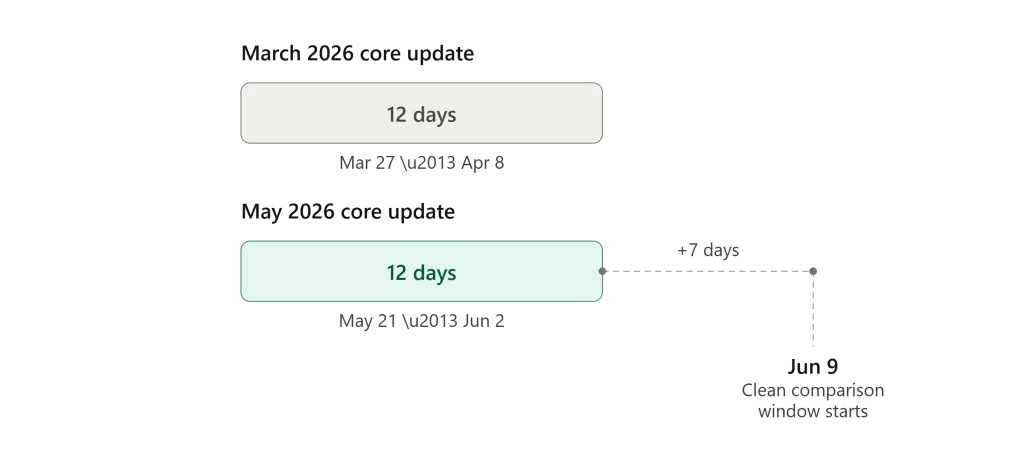
Anyone whose traffic moved between May 21 and June 2, 2026 was likely caught in this rollout. It ran for just under 12 days, almost identical in length to the March 2026 core update, which also took 12 days, from March 27 to April 8.
What’s worth noting is how little has changed in Google’s messaging. No new advice came with this release, no special checklist, nothing different from the standard line about surfacing content that satisfies what people are actually searching for. For anyone already building around helpful, people-first content, this update wasn’t a signal to do anything differently. It was a signal to keep going.
Where it fits in the 2026 update sequence
Context matters here, because May didn’t arrive in a quiet year. A Discover-focused core update ran through February for 22 days. Late March brought a short spam update, wrapped within a day, followed almost immediately by the March core update.
Stack those together and 2026 had already delivered three rounds of algorithm movement before May even started. For sites still settling from earlier changes, this update added another layer on top, which is exactly why isolating “what did May actually do” became a messier question than usual.
How May compared to March in scale and impact
March was, for most sites, a non-event. Quiet enough that plenty of people didn’t notice it at all. May broke that pattern. It felt closer to the kind of core update that actually moves things, visible across different industries and countries rather than confined to a few corners of search.
What stands out is how split the outcomes were. Some sites picked up real traffic gains over a single weekend during the rollout, while others dropped just as sharply in that same window. Two sites could have been hit by the exact same update and walked away with opposite stories, which is part of what made this one feel heavier than March.
There’s a catch worth flagging before anyone reads too much into early numbers. Movement happened at multiple points across the 12-day rollout, not just at the start and the finish. A page that shifted on May 24 isn’t necessarily telling the same story as one that shifted on June 2, even though both technically happened “during the May update.”
That’s the reasoning behind Google’s advice to wait before drawing conclusions. The first clean comparison window lands around June 9, a full week after the rollout closed. Comparing that week against the week before May 21 gives a far more honest read than reacting to whatever happened on any single day during the rollout.
The I/O 2026 Backdrop
What Google announced the same week
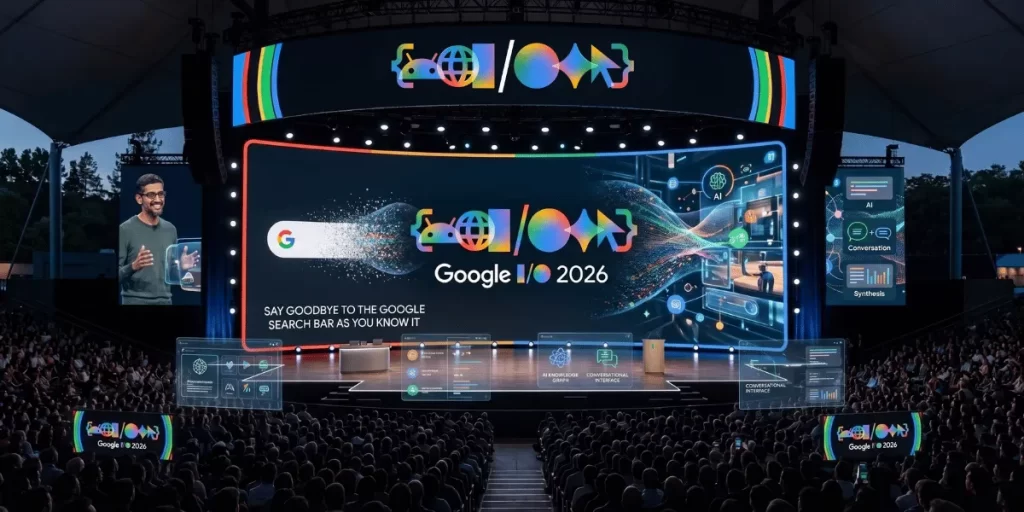
The timing here is hard to ignore. Google I/O 2026 took place the same week as the May core update, and Search got more attention than it usually does at a developer conference.
The headline change was a new default model powering AI Mode, described as Google’s most capable version yet for handling complex, multi-step requests. Alongside that came a redesign of the search box itself, described as the biggest change to that interface in over two decades. The new version expands as people type, accepts text, images, video, or files as input, and is built to handle vague or exploratory questions rather than just short keyword strings.
Beyond the search box, Google introduced the idea of “information agents,” tools that run continuously in the background and surface updates on topics a person cares about, whether that’s a price drop, a news development, or a change in availability for something they’re tracking. Booking-related tasks got an expansion too, covering things like restaurant reservations and local services, with some categories allowing Google to contact a business directly on someone’s behalf.
There was also a push toward what Google calls personal intelligence, where AI Mode can connect with apps like Gmail and Photos, with a calendar integration planned, to give more context-aware answers. All of this rolled out gradually starting that week, with some features limited to certain regions or subscription tiers at launch.
Why the timing got so much attention
It’s easy to see why so many people lined up the core update with these announcements. Both landed in the same narrow window, and for site owners watching their rankings shift while reading about a major AI overhaul on the same day, connecting the two felt natural.
That said, nothing in Google’s own description of the core update ties it to these AI features. The core update was framed in the same general terms Google always uses, a broad systems refresh aimed at surfacing better content, not a rollout tied to a specific model or interface change. Whether the two are connected under the hood isn’t something that’s been confirmed either way.
What can be said with more confidence is this: the same week introduced a lot of new ways for Google to understand and respond to queries, while the ranking systems underneath were also shifting. Even without a confirmed link, those two things happening together gives useful context for why this update felt different to so many people, and why some of the shifts in source-type visibility, covered later in this piece, line up with a search experience that’s leaning harder into AI-generated responses.
Stack those together and 2026 had already delivered three rounds of algorithm movement before May even started. For sites still settling from earlier changes, this update added another layer on top, which is exactly why isolating “what did May actually do” became a messier question than usual.
What Google’s own messaging said about the core update
Stripped of the AI Search noise, Google’s actual statement about the core update was short and familiar. It confirmed the release, gave the expected rollout window of up to two weeks, and repeated the same guidance it has offered for every core update going back years: there’s nothing special required from site owners, and the focus should stay on creating content that’s genuinely useful for the people reading it.
No new ranking factors were named. No new tools were introduced specifically for this update. For anyone trying to separate signal from noise that week, the core update itself was the quiet part of the announcement, even if the surrounding news made it feel like anything but.
Entities, the Knowledge Graph, and the Intent-Destination Reset
From keyword matching to entity and intent matching
For a long time, ranking well meant getting the right words on the page. Match the search term, cover the related terms, structure the content so Google could parse it easily, and visibility tended to follow. That model hasn’t disappeared, but the May 2026 update is another data point showing how far behind it’s falling compared to how Google actually evaluates pages now.
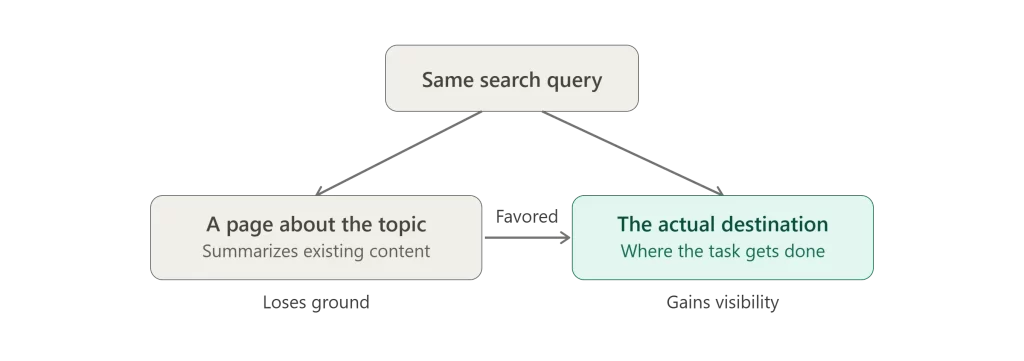
What seems to matter more is whether a page represents something Google can recognize as a distinct entity, a brand, a person, a place, a tool, a specific product, and whether that entity fits what someone is actually trying to do. Two pages can target the exact same keyword and still get treated very differently if one of them reads as “the place to get this done” and the other reads as “a page that talks about this topic.”
This isn’t a new idea. Entity-based search has been part of Google’s thinking for years. What’s notable about this update is how clearly the visibility shifts line up with that framing, once you look past the headline winners and losers.
How the “expected destination type” concept works
There’s a simple question buried in this update that’s easier to ask than to measure: for any given search, what type of result does the person expect to land on? Watching how sites moved during this rollout, the pattern that keeps showing up is that Google leaned toward whichever site matched that expected type, almost regardless of how authoritative it generally is.
That distinction matters because authority alone didn’t protect everyone. Several large, well-known sites, including major news publishers, academic publishers, and government health sites, lost visibility during this window. Being a trusted name wasn’t enough if the page wasn’t the kind of result the query called for.
Flip that around, and some sites with narrower reputations gained ground simply because they were a better match for what the result format demanded. A page built to be a definitive reference can outperform a much bigger site if the bigger site is offering something adjacent rather than the thing itself.
The practical question this raises for any site is worth sitting with: for the searches that matter most, is the page actually the destination someone expects, or is it something close to that, a summary, a comparison, a secondary source, standing in for the real thing?
Reference brands vs aggregators as a case study
The clearest illustration of this shift shows up in the reference and language space, partly because the query overlap is so direct. People searching for word meanings, pronunciations, and translations have a lot of overlapping intent, but the May update treated different types of sites in that space very differently.
Dictionary brands, the names people already think of when they want a definition, came out ahead during this rollout. Sites like Cambridge’s dictionary, Merriam-Webster, and Thesaurus.com all picked up visibility, reinforcing what most people already associate with those names.
Tools built around pronunciation, translation, or repackaged definitions told a different story. Several of these saw steep drops, in some cases losing more than half their visibility, and a few lost considerably more than that. Language Q&A platforms and dictionary aggregation sites followed a similar pattern.
Here’s what makes this pairing worth thinking about: these sites weren’t competing on different topics. They were often answering the same underlying questions. The difference was in what kind of source each one represented, a primary, recognizable reference versus a layer built on top of other people’s content. Whatever shifted in this update, it seems to have leaned hard toward the primary source.
A similar pattern showed up outside the reference space too. A major lyrics platform held its ground while smaller lyric aggregation sites dropped noticeably. Scientific publishing platforms with a strong primary-source identity stayed stable while some of the publishers feeding into them lost ground. The common thread isn’t the topic, it’s the role each site plays for that topic.
For anyone auditing their own content against this, the useful exercise isn’t just checking rankings. It’s asking, honestly, what role a page plays for its target query. Is it the thing people are looking for, or is it a page about the thing people are looking for? That’s the gap a lot of this movement seems to map onto.
Winners and Losers by Category
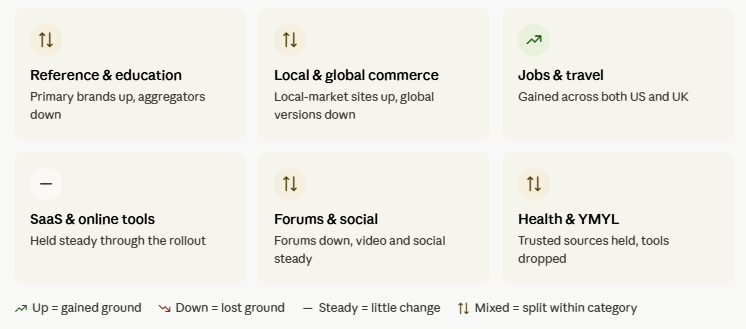
Putting this together meant going through a lot of noise. Industry blogs, forum threads, and update trackers were full of theories during and after the rollout, some convincing, some not. Cross-referencing those patterns against what showed up across client accounts during the same window helped separate the parts that held up from the parts that were just speculation. The categories below are the ones where the patterns were consistent enough, across both outside reporting and what was visible firsthand, to be worth writing about.
Local commerce and the UK market shift
One of the more practical shifts from this update showed up in ecommerce, particularly for businesses operating across different country markets. The pattern that emerged was fairly direct: local versions of retail sites, the ones built specifically for a given country’s market, gained ground in that country’s search results, while the general .com versions of the same brands lost visibility there.
This showed up clearly in the UK. Retailers with a dedicated UK presence, whether that’s a country-specific domain or a clearly localized site, picked up visibility in UK search results. At the same time, the broader .com versions of major marketplaces dropped sharply when UK users searched, even though those same .com sites held steady or stayed roughly flat for US searchers looking at the same products.
The takeaway here isn’t really about domain extensions specifically. It’s about whether the page a searcher lands on actually fits their market. Pricing in the right currency, shipping that makes sense for where someone lives, reviews from people in the same country, support that operates in their time zone, these are the kinds of signals that seem to matter more now. For any business selling across borders, this is worth a serious look. A page that’s technically findable but clearly built for a different market isn’t doing the job Google now expects it to do.
Jobs and travel marketplaces
This category is probably the best argument against the idea that “aggregators got hit” by this update. Job boards and travel booking platforms, both of which aggregate listings from many different sources, didn’t just hold steady. Several of them gained meaningfully, in some cases by a significant margin, across both the US and UK.
What separates these from the aggregators that lost ground seems to come down to one thing: these are places where someone can actually complete the task. A travel marketplace lets someone book the trip right there. A job board lets someone apply. That’s different from a page that summarizes information someone could just as easily find at the original source.
This distinction matters a lot for anyone running a comparison site, a directory, or an affiliate-style page. “Aggregator” isn’t the problem by itself. The question is whether the aggregator is the destination, the place where the task gets done, or just another layer between the searcher and the actual answer. The jobs and travel data suggests Google is increasingly comfortable ranking aggregators highly when they’re the former.
SaaS and online tools
That same “is this a real destination” question shows up just as clearly, if a lot more quietly, in SaaS and online tools. Across several client accounts in this space, the rollout was almost a non-event. Rankings stayed where they were, traffic patterns held steady, no surge and no drop, while a lot of other sites were swinging in one direction or another during the same window.
This fits the pattern from the previous section more than it might seem at first. A tool that does something useful, a calculator, a converter, a generator, a piece of software someone signs up for and actually uses, is already the destination. There’s no “more authoritative” version of a working tool sitting somewhere else. The page either does the job or it doesn’t, and that’s not really something a core update needs to re-evaluate.
This is a useful reminder before getting into the categories that did move. A lot of what’s covered in this article is about content, pages built to inform, summarize, or rank for a topic, getting reassessed against other content. Sites built around a functioning tool or product sit in a different category almost by default. If the thing on the page is genuinely useful and does what it says, this update doesn’t appear to have had much reason to touch it.
That doesn’t mean SaaS and tool sites are immune to future updates, or that the content sections of those same sites, blogs, guides, comparison pages, follow the same pattern. Those pages are still content, and still get evaluated the way content does. But the core tool or product pages themselves seem to be in a category where stability, not movement, was the story this time.
With that baseline in place, the categories below show what happened where things weren’t quite so settled.
Forums, Q&A, and social platforms
This is where things get more nuanced than a simple headline would suggest. Forum and Q&A style platforms, the kind built around community discussion and user-submitted answers, lost visibility during this update. That includes some of the largest community platforms on the web, which had previously benefited from Google’s push toward first-hand, real-person content in recent years.
But it would be a mistake to read this as “user-generated content lost.” Large social platforms built around video, images, and shorter posts didn’t follow the same pattern. Several of these held steady or gained ground over the same period, in both the US and UK markets.
The difference seems to be format rather than source. A forum thread is text-heavy, often meandering, and frequently buried in older discussion. A video or visual post tends to be more direct and easier for Google to match to a specific intent. If Google’s systems are increasingly favoring formats that match what a search result page is expected to look like, then it makes sense that visual and video content held up better than long-form discussion threads, even when both come from similar types of platforms.
For sites that have leaned on forum-style content or community Q&A as a traffic strategy, this is worth watching closely over the next few updates. It might be a temporary dip tied to this specific rollout, or it might be an early sign that the “hidden gems” advantage these platforms enjoyed for the past couple of years is starting to fade.
Health and YMYL
Health content sits in Google’s “your money or your life” category, meaning it gets extra scrutiny because bad information here can cause real harm. This update didn’t treat health as a single block that either won or lost. Instead, it split along two lines: how much trust a source carries, and whether it matches what the searcher actually needs.
Established health information sites, the kind people already recognize as trustworthy medical references, generally held their position or gained slightly. That’s consistent with how Google has approached YMYL content for years.
What’s more interesting is that even some highly authoritative sources, including major health organizations and government health sites, saw drops in this window. At the same time, certain utility-style health tools, like symptom checkers or drug price comparison tools, saw some of the steepest declines of any category covered here.
The lesson for health-adjacent content seems to be that trust is necessary but not sufficient. A page can come from a credible source and still lose ground if it’s not the type of result the query calls for. A general health authority page and a tool that helps someone compare drug prices are answering different needs, even if they sit in the same broad topic area, and this update seems to have judged each one against its own specific job rather than against the health category as a whole.
A note on derivative content patterns
One pattern that came up repeatedly, both in outside discussion and in a couple of client accounts during this rollout, involves large volumes of templated, automated content, often organized into dedicated sections or subfolders of a site, built primarily to capture search volume rather than to serve a specific audience.
Visibility drops for this kind of content were sharp and consistent enough across different sites that it didn’t look like a coincidence. That lines up with the broader theme running through this entire update: content that mostly repackages information already available elsewhere, without adding anything original, seems to be where the exposure is concentrated. Whether these points to something Google specifically targeted, or whether it’s simply this same derivative-content pattern playing out at scale across large sections of certain sites, isn’t something that can be said with certainty. Either way, it fits the direction everything else in this update points toward.
March vs May 2026: How the Recalibration Evolved
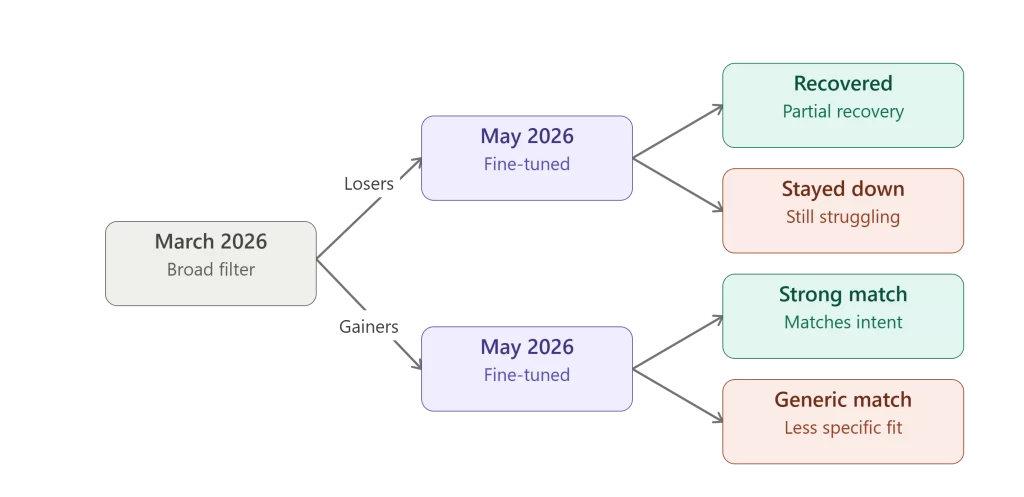
It’s tempting to treat each core update as its own isolated event, a fresh reset with no connection to what came before. But looking at March and May together tells a more useful story, one where May reads less like a separate update and more like a continuation of something that started two months earlier.
What’s worth noting is how little changed in Google’s messaging. No new advice came with this release, no special checklist, nothing different from the standard line about surfacing content that satisfies what people are actually searching for. For anyone already building around helpful, people-first content, this update wasn’t a signal to do anything differently. It was a signal to keep going.
What "March" consolidated
March 2026 set a direction more than it delivered a dramatic shakeup. The general shift was away from pages that sat between a searcher and the thing they actually wanted, intermediary content, broad directories, layers that summarized or aggregated information from elsewhere, and toward stronger, more direct destinations.
At the time, this looked like a fairly broad move. Plenty of sites that functioned as “middle layers” lost some ground, while sites that were closer to being the actual answer or the actual source held up better. It wasn’t a precise recalibration so much as a general lean in one direction.
What "May" refined further
May took that same general direction and made it sharper. Instead of a broad shift away from intermediary content as a whole, the May update looked more like Google working out, query by query and market by market, which specific type of destination fits best.
This is where the local-market dimension comes in. March didn’t show much evidence of country-specific recalibration. May did, with the same brand performing very differently depending on which country’s search results it showed up in. That’s a level of precision that wasn’t really visible in March.
There’s also a useful correction worth noting. Some sites that lost ground in March, particularly in categories like jobs and travel, recovered some of that ground in May. That’s a reminder that core updates aren’t always one-directional. A site that got swept up in a broad March shift wasn’t necessarily judged as “bad”, it may have just been caught in a wider net that May then narrowed.
Read together, March feels like Google identifying a general problem, too much reliance on intermediary layers, while May feels like Google working out the details of what should replace them. For anyone tracking both updates, the sites that struggled in March and continued to struggle in May are likely dealing with something more structural. The ones that struggled in March but recovered in May may have simply been on the wrong side of a broad-strokes change that got refined into something more specific.
Your Recovery Roadmap
Everything covered so far explains what happened and why. This section is about what to actually do with that information, especially if a site lost ground during this rollout and the question now is what comes next.
Waiting for a clean Search Console window
The instinct after any visible drop is to start making changes immediately. With this update, that instinct works against you. Because ranking movement happened at multiple points throughout the 12-day rollout, anything pulled from Search Console during that window is mixing together several different signals at once.
Google’s own guidance points to waiting roughly a week after the rollout completes before drawing conclusions, which lands around June 9 for this update. The comparison that actually means something is the week starting around June 9 against the week before May 21, the period right before the rollout began. That gives a clean before-and-after, rather than a snapshot taken in the middle of a moving target.
This is the least exciting step in any recovery process, and also the one most people skip. Skipping it usually means reacting to noise instead of signal.
Diagnosing and bucketing affected pages
Once that clean window is available, the next step is sorting through what actually changed, page by page rather than site-wide. Site-wide averages hide too much. A site can show a small overall dip while one section dropped hard and another section quietly gained, and those two stories need very different responses.
A useful way to sort affected pages is into three rough buckets:
- Thin or low-effort pages. Content that exists mainly to target a keyword, without much depth, original insight, or reason for someone to stay on the page.
- Derivative pages. Content that mostly summarizes or repackages what other sources already say, without adding analysis, experience, or a distinct point of view.
- Pages caught in volatility. Strong, useful pages that moved during the rollout for reasons that don’t seem connected to quality, possibly just part of the broader churn during a heavy update.
That third bucket matters as much as the first two. Not every drop is a quality signal, and treating a genuinely strong page like it’s broken can do more harm than leaving it alone.
Assessing pages against Google’s helpful content questions
For pages that land in the thin or derivative buckets, the next step is holding them up against the questions Google has published as part of its guidance on helpful, reliable, people-first content. A few of these matter more than others after a core update:
- Does the page offer original information, research, analysis, or reporting, something that isn’t just available elsewhere in the same form?
- Does it add insight beyond what’s obvious or already widely known?
- Is it written by, or reviewed by, someone who clearly knows the subject?
- Does it read as something made for the person reading it, or something made to attract a search click?
Running a page through these questions usually makes the gap obvious pretty quickly. Sometimes the gap is depth, the page covers the topic but doesn’t go anywhere beneath the surface. Sometimes it’s experience, the page explains something in theory without showing any sign the writer has actually done it. Sometimes it’s just structure, the useful information is buried under filler that exists to hit a word count.
Fixing depth and demonstrated expertise rather than deleting
Once the gap is identified, the fix should match it. Deleting underperforming content might feel like the cleanest option, but Google treats that as a last resort, reserved for pages that were built primarily for search engines rather than for people. For most pages, especially ones that already have some history and some links pointing to them, improving is the better path.
What “improving” looks like depends on the gap:
- If the issue is depth, that means going further into the topic than a surface-level overview, adding specifics, examples, or detail that a quick summary wouldn’t include.
- If the issue is experience, that means adding a perspective that comes from actually having done the thing, not just researched it. A clear point of view, a specific example, a result that was actually observed.
- If the issue is expertise and authorship, that means making it obvious who wrote the page and why they’re qualified to. A real name, a real background, something that signals this wasn’t assembled anonymously.
- If the issue is structure, that means reorganizing so the actual answer is easy to find, for a human reader and for anything else trying to extract information from the page.
None of this is exotic. It’s the same advice that’s been around for a while, just with more urgency attached to it now.
Republishing and monitoring two surfaces
After a page has been genuinely improved, the next step is republishing it and requesting indexing so Google has a chance to recrawl it sooner rather than waiting for its natural cycle.
From there, monitoring needs to cover two things, not one. The first is the familiar one: classic rankings and organic traffic in Search Console. The second is newer and easy to overlook: whether the page shows up as a source inside AI Overviews or AI Mode responses for relevant queries.
These two surfaces run on the same underlying systems, which means a genuine quality improvement has a reasonable chance of moving both. But they don’t always move together or at the same pace, so checking only one gives an incomplete picture. A page might hold steady in classic rankings while gaining or losing ground in how often it gets cited in AI-generated answers, and that’s worth knowing either way.
A first-hand look at the data
Beyond what’s been reported and discussed elsewhere, it’s worth looking at what actually showed up across client accounts during this window, with the caveat that this is a small sample and shouldn’t be read as a verdict on the update as a whole.
The clearest pattern was on the well-established side. Sites with solid traffic histories, including SaaS platforms, business websites, and local business sites, showed little to no negative impact from this update. That lines up with the SaaS and tools observation covered earlier in this piece, and extends it a bit further: it wasn’t only tool-based pages that stayed stable, established content on these sites largely held its position too.
The exception was two newly indexed websites, both of which saw clicks and impressions that were already low drop to single digits or zero during the rollout. Before reading too much into that, there’s an obvious confound worth naming: both sites were new, and indexing reports showed they hadn’t been fully crawled at the time. A new site with incomplete indexing is going to look unstable during any major update, core update or not, simply because Google doesn’t have a complete picture of it yet.
So this isn’t evidence that new sites get specifically targeted by core updates. It’s more a reminder that timing matters. Launching a new site right before, or during, a major rollout adds a layer of noise that makes it hard to separate “this update affected the site” from “this site wasn’t fully indexed yet.” For anyone in that position, the more useful step is making sure the site is fully crawled and indexed first, then giving it time before reading much into how it performs around an update.
What This Means for AEO and GEO
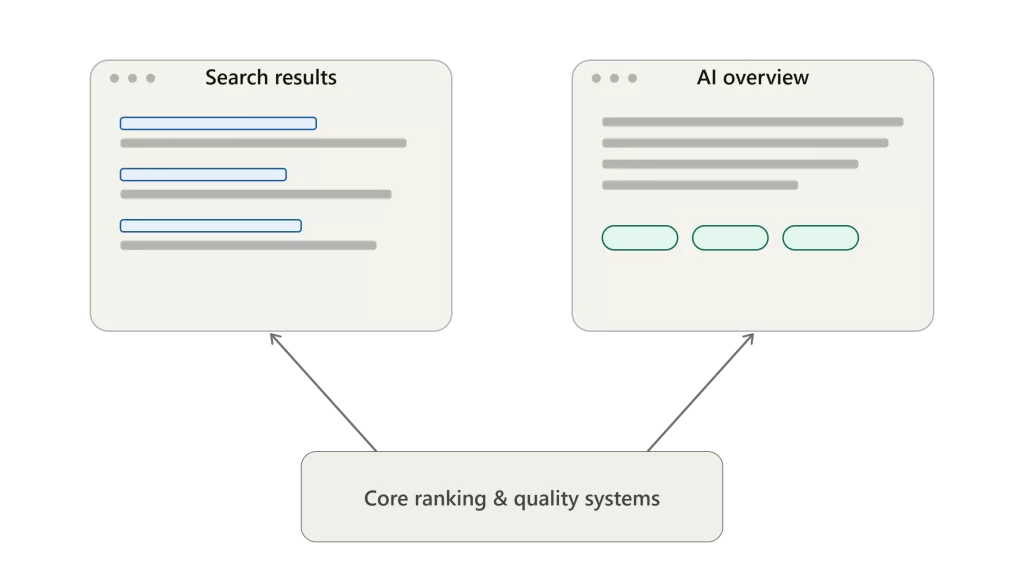
Most of this article has focused on classic search rankings, but that’s only half the picture now. The same systems that decide what shows up as a blue link also decide what gets pulled into AI Overviews and AI Mode responses, and a core update touches both at once.
Why core updates affect AI Overview and AI Mode citations
Google has been fairly direct about this in its own documentation: its AI-powered search features are built on top of the same core ranking and quality systems used for regular search results, not a separate process running alongside them. That means a broad change to those core systems, which is exactly what a core update is, doesn’t stay contained to the list of links on a results page.
In practice, this shows up as a second layer of movement. A page can hold its position in classic rankings while quietly losing ground in how often it gets pulled into an AI-generated summary, or the reverse can happen, a page gains visibility inside AI answers without much change to where it sits in the regular results. Both are forms of movement worth tracking, and neither one tells the whole story on its own.
This connects directly to everything covered in the Entities section earlier. If Google is increasingly matching queries to the “expected destination type” for a result, that same logic applies when an AI system is deciding which sources to pull from and cite. A page that reads as a primary, authoritative source for its topic is in a stronger position on both fronts, not because of some separate AI-specific trick, but because it’s the same underlying judgment being applied twice.
Visibility inside AI summaries as an emerging consideration
As AI-generated answers take up more space on results pages, some people in the SEO community have started talking informally about how often a brand or page gets mentioned inside those summaries, treating it as something worth watching alongside traditional click-through rate. There isn’t a standardized way to measure this yet, and no agreed-upon name for it either, but the underlying idea is reasonable: getting clicked on a results page and getting referenced inside an AI answer are two different forms of visibility, and a page can do well on one without doing well on the other.
For now, the most practical approach is treating this as an extension of the same fundamentals rather than a separate discipline. A page that’s genuinely the best answer to a question, with clear authorship, real depth, and information that isn’t just copied from somewhere else, is in a good position to be picked up by an AI system for the same reasons it would rank well normally. There’s no separate checklist for “getting cited by AI” that exists apart from the checklist for “being a good result.”
Managing AI crawler access as part of technical foundations
One technical detail that’s easy to overlook in all of this is crawler access. As more AI systems crawl the web, both for training and for retrieving information to answer queries in real time, robots.txt and crawler management become part of the conversation in a way they weren’t a few years ago.
This doesn’t mean every site needs to make dramatic changes to how it handles crawlers. But it’s worth knowing which automated systems are allowed to access a site, and whether that matches what the site owner actually wants. A page that’s blocked from a particular crawler isn’t going to show up in whatever that system produces, whether that’s a training dataset or an AI-generated answer. For most sites, this is a quick audit rather than an overhaul, but it belongs on the same list as the other technical basics, alongside sitemaps, site speed, and clean indexing.
Google Reinforces Its Position on AEO and GEO
A couple of weeks after the May core update finished rolling out, Google published updated guidance that, while not directly tied to the update itself, says a lot about how Google wants AEO and GEO to be understood going forward.
What the June 5 third-party SEO guidance says
On June 5, Google updated its documentation around third-party SEO tools, services, and advice, alongside its existing guidance on hiring an SEO. The update explicitly names AEO and GEO, “answer engine optimization” and “generative engine optimization,” as terms now common enough that Google felt the need to address them directly.
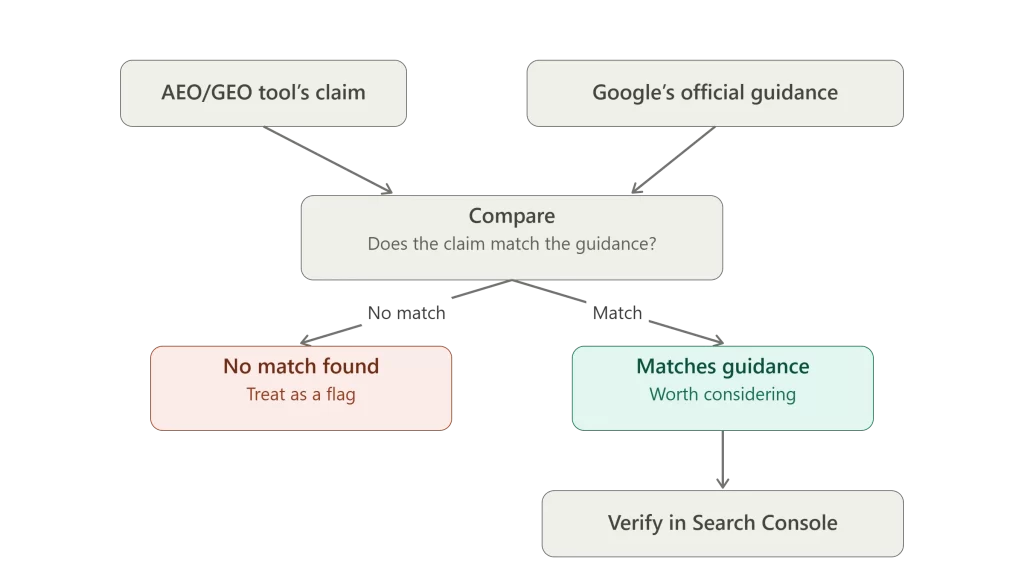
The core message is straightforward. Google positions its own documentation as the reference point for evaluating any SEO advice, including advice specifically about AI search visibility. It calls out several categories of third-party services by name, including tools that promise improvements for AI experiences, and says plainly that these tools don’t have access to Google’s internal ranking data and can’t guarantee performance. The guidance also points people back toward Search Console as the first-party source for understanding how a site is actually performing.
None of this is framed as new rules or new ranking factors. It reads more like Google drawing a clearer line around a space that’s gotten crowded with tools and services making claims Google itself hasn’t endorsed.
Why this matters for AEO and GEO specifically
The timing here is worth sitting with. Two weeks after a core update that reshuffled visibility across classic search and, by extension, AI-generated answers, Google published guidance specifically addressing the tools and services built around optimizing for those AI answers.
Read together, the message lines up with everything covered in the AEO section above. There’s no separate system being optimized for, and no special toolkit that produces results outside of what already works for regular search. The guidance doesn’t say AEO and GEO are meaningless terms, it acknowledges they’re commonly used, but it pushes back on the idea that they represent some distinct discipline with its own rules, separate from the fundamentals that have applied all along.
For anyone who’s been approached by a tool or service promising to improve “AI visibility” through some method that sounds disconnected from normal SEO work, this guidance is a useful reference point. If a claim can’t be tied back to something in Google’s own documentation, that’s worth treating as a flag rather than a feature.
The throughline: fundamentals over tools
Pulling this back to the bigger picture, the May 2026 core update and the guidance that followed it two weeks later both point in the same direction, even though they’re technically separate events.
The core update showed, through real movement across categories, that primary sources, demonstrated expertise, and genuinely useful content held up better than derivative or templated pages. The June 5 guidance then reinforced, in plain language, that the path to visibility in AI-generated answers runs through the same fundamentals, not around them.
This is also where it’s worth connecting back to a piece written earlier this year on SEO, GEO, and AEO, which made a similar argument before either of these events happened: that GEO and AEO are mostly SEO fundamentals with new labels attached. Nothing about the May update or the June guidance contradicts that. If anything, both add fresh evidence to it.
Things People Are Asking About This Update
Is the May 2026 core update a penalty?
No. Core updates aren’t penalties, and a drop in rankings after one doesn’t mean a site did something wrong in a way that needs to be “fixed” with a specific action. What a core update does is reassess, broadly, which pages best serve a given search. A page that drops might still be a perfectly fine page, it just may not be the best match for that query anymore, especially if other pages have improved or if Google’s sense of what that query needs has shifted.
How long does recovery take?
Usually weeks to months, not days. Some recovery can happen between core updates if a page genuinely improves, but the bigger shifts tend to align with the next core update, when Google’s systems get another broad pass at reassessing everything. No fixed timeline applies to every site, which is part of why patience matters more than quick fixes here.
Did directories and aggregators really lose out?
Not as a category, no. This update is a good example of why broad statements like “aggregators lost” don’t hold up well. Some aggregator-style sites, particularly in jobs and travel, gained ground. Others, mostly in reference, language tools, and forum-style content, lost ground. The dividing line wasn’t whether a site aggregated information, it was whether the site functioned as a real destination where someone could complete what they came to do, versus a layer that mostly summarized what was available elsewhere.
Does this update affect AI Overviews and AI Mode?
Yes. Google’s AI-powered search features run on the same core ranking and quality systems as regular search results, so a broad change to those systems affects both. A page can see movement in classic rankings, in how often it gets cited inside AI-generated answers, or both, and these don’t always move in the same direction or at the same pace. Tracking only one of these surfaces after an update like this gives an incomplete picture.
How is May different from March 2026?
March set a general direction, away from intermediary and aggregator-style content and toward stronger destinations, but it worked at a fairly broad level. May took that same direction and made it more precise, working out which specific type of destination fits best for a given query and market. May also introduced a clearer local-market dimension that wasn’t really visible in March, where the same brand could perform very differently depending on which country’s search results it showed up in. Some sites that lost ground in March even recovered some of it in May, once the broader shift got refined into something more specific.
Further Reading
For anyone who wants to dig into Google’s own documentation behind some of the points raised in this piece, here’s where to look.
- Google’s documentation on core updates explains how these updates work and what to expect if a site is affected.
- Creating helpful, reliable, people-first content lays out the self-assessment questions referenced in the recovery section above.
- Google’s guidance on third-party SEO tools and advice is the June 5 update covered in the AEO and GEO section, worth reading in full if AEO or GEO tools come up in client or vendor conversations.
- Google’s announcement on AI Search updates from I/O 2026 covers the AI Mode, search box, and agent changes referenced earlier in this piece.
About the Author

Ashan Kusalanka
SEO Consultant with 10+ years of experience helping local and global businesses strengthen their digital presence. I design strategies that improve visibility, build authority, and drive sustainable growth.